
Flow Of Water Through A Capillary Tube Experiment
On This Page
-
IntroductionIntroduction
-
AimAim
-
ToolsTools
-
Steps & MethodsSteps & Methods
-
Parameters, Theory & Final LawParameters, Theory & Final Law
-
Table of The readingsTable of The readings
-
Medical ApplicationMedical Application
Introduction Of The Flow Of Water Through A Capillary Tube Experiment
This flow rate is of great importance in our lives since it governs things like the flow of blood round our bodies and the transmission of gas, water or oil through long distances in pipelines.
Aim Of The Flow Of Water Through A Capillary Tube Experiment
-To show that the rate of flow is proportional to the applied pressure.
-To deduce the viscosity of water
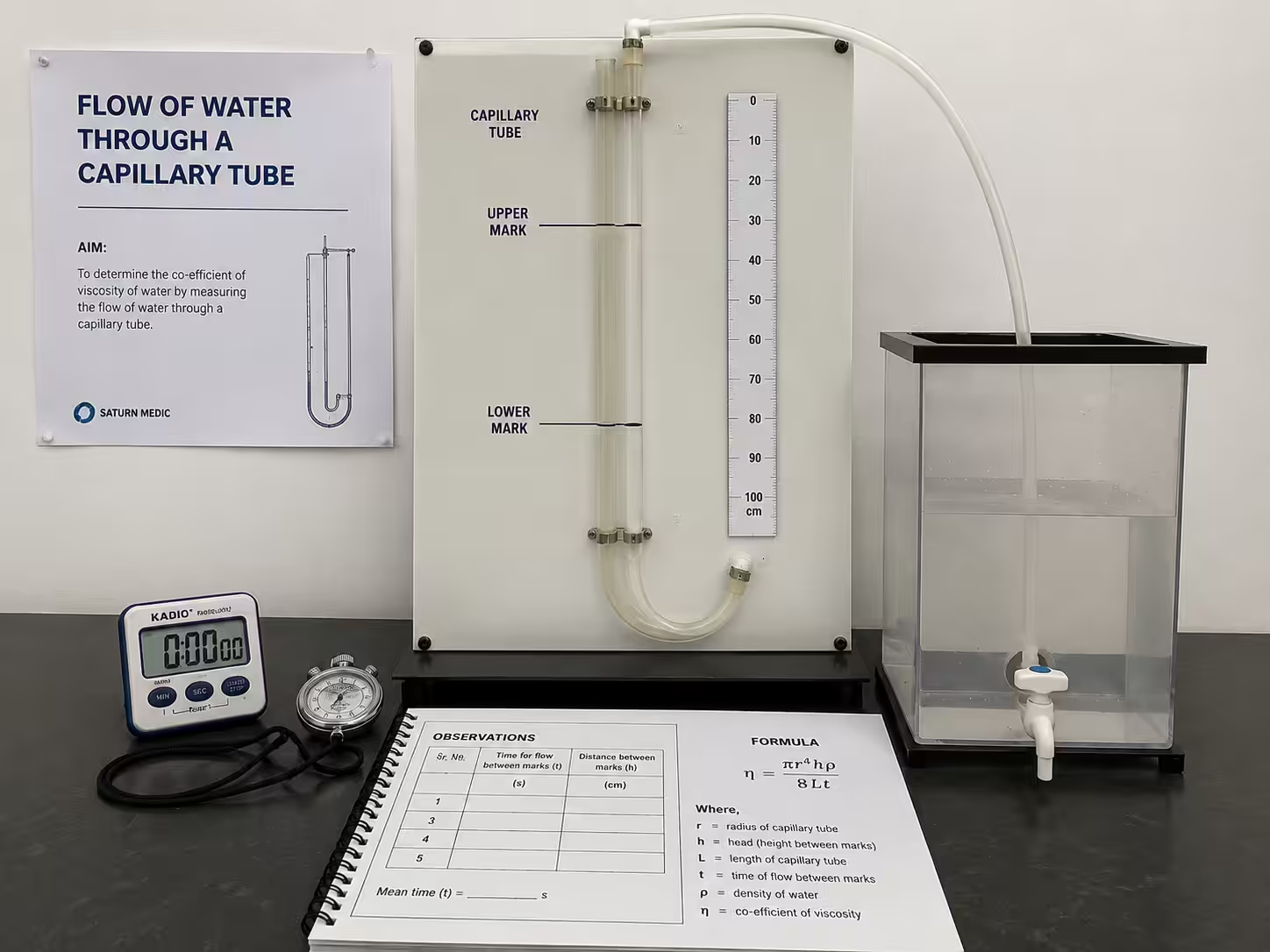
Tools Of The Flow Of Water Through A Capillary Tube Experiment
- Glass capillary tube (internal diameter: 0.5–1 mm; length: approximately 30 cm)
- Constant-head apparatus
- Small beaker
- Burette
- Stopwatch or clock
- Thermometer
- Spirit level
- Travelling microscope
- Metre scale
- Dilute nitric acid
- Dilute caustic soda solution
- Two stands with clamps
- Rubber tubing
Steps And Method of The capillary tube experiment
- First measure the mean internal diameter of the capillary tube by the travelling microscope, taking the mean of four readings-two at right angles to each other at each end of the tube.
- Measure also the length I of the capillary tube.
- Clean the capillary tube by washing successively in nitric acid, caustic soda and lastly in tap-water.
- Set the constant head apparatus A in a clamp beneath a water tap and see that the waste outlet W discharges into the sink.
- Another outlet M may be provided on the apparatus already connected to a glass manometer.
- Connect the constant head outlet H to the cleaned capillary tube, held horizontally in a clamp, by a piece of rubber tubing sufficiently long to enable the constant head apparatus to be moved vertically up and down relative to the capillary tube.
- Use the spirit level to check that the flow tube is horizontal.
- Turn on the flow of water and adjust the height of the constant head apparatus so that water issues from the open end of the capillary tube in a succession of drops.
- Put a smear of grease on the underside of the tube to prevent the water from running back along the outside of the tube. Place a thermometer in the constant head apparatus.
- When conditions are steady allow the water to drop into an empty beaker which has been rinsed out in water but not dried.
- After a measured time of about 5 minutes pour the collected water into a burette which already contains water up to the lowest markings and from the difference in readings measure the volume of water collected.
- Read the vertical height h of the level of the water in the manometer tube (or constant head apparatus) above the level of the bore of the flow tube. Repeat the experiment for different values of h, varying the rate of flow as much as possible without allowing the flow to become either rapid or turbulent
Parameters, Theory And Final Law of The Capillary Tube Experiment
Parameters, Theory & Final Law
η
Viscosity of water
N·s·m⁻²
d
Diameter of the capillary tube
m
ρ
Density of water
kg/m³
g
Gravitational acceleration
m·s⁻²
l
Length of the capillary tube
m
QN
Applied pressure
cm
PN
Rate of flow of water
cm³ s⁻¹
Poiseuille's equation for the rate of flow V/t is:
vt
=
πr4hρg8ηl
=
π(½d)4hρg8ηl
η =
π(½d)4ρg8L
×
hv/t
The mean value of h / (v/t) is numerically equal to:
QN × 10⁻²PN × 10⁻⁶
since QN is in cm and PN is in cm³ s⁻¹.
Final Law
η =
π(½d)4ρg8L
×
hv/t
Table Of The Flow Of Water Through A Capillary Tube Experiment
| h/cm | Burette readings | Volume collected v/cm³ From V = v1 − v2 |
Time taken t/s |
Rate of flow v/t / cm³ s⁻¹ |
|
|---|---|---|---|---|---|
| First V1/cm³ |
Second V2/cm³ |
||||
© Saturnmedic.com
Frequently Asked Questions About Capillary Tube Experiment
Why does flow rate depend on radius to the fourth power?
Poiseuille's Law shows that flow rate scales with r⁴, meaning even small changes in tube radius produce dramatically larger changes in flow. This is why a slightly narrower vessel can restrict blood flow far more than intuition suggests.
Why is the capillary tube cleaned with acid and caustic soda before use?
Residue or grease inside the tube changes its effective diameter and surface properties, which would distort the flow-rate measurements. Cleaning ensures the water flows through a consistent, unobstructed bore.
Why must the flow remain non-turbulent during the experiment?
Poiseuille's Law only holds for laminar (smooth, layered) flow. If the flow becomes turbulent, the relationship between pressure, radius, and flow rate breaks down, making the viscosity calculation inaccurate.