

Clinical Subject Page
Acute Limb Ischemia (ALI)
ICD-10
I74.3
Specialty
Cardiology
Onset
Acute
Reviewed
July 2026
On This Page
-
OverviewOverview
-
Etiology & Risk FactorsEtiology & Risk Factors
-
PathophysiologyPathophysiology
-
Clinical PresentationClinical Presentation
-
History TakingHistory Taking
-
PhysicalExaminationPhysicalExamination
-
InvestigationsInvestigations
-
DiagnosisDiagnosis
-
ManagementManagement
-
ComplicationsComplications
-
PrognosisPrognosis
-
Key Points / Clinical PearlsKey Points / Clinical Pearls
Overview
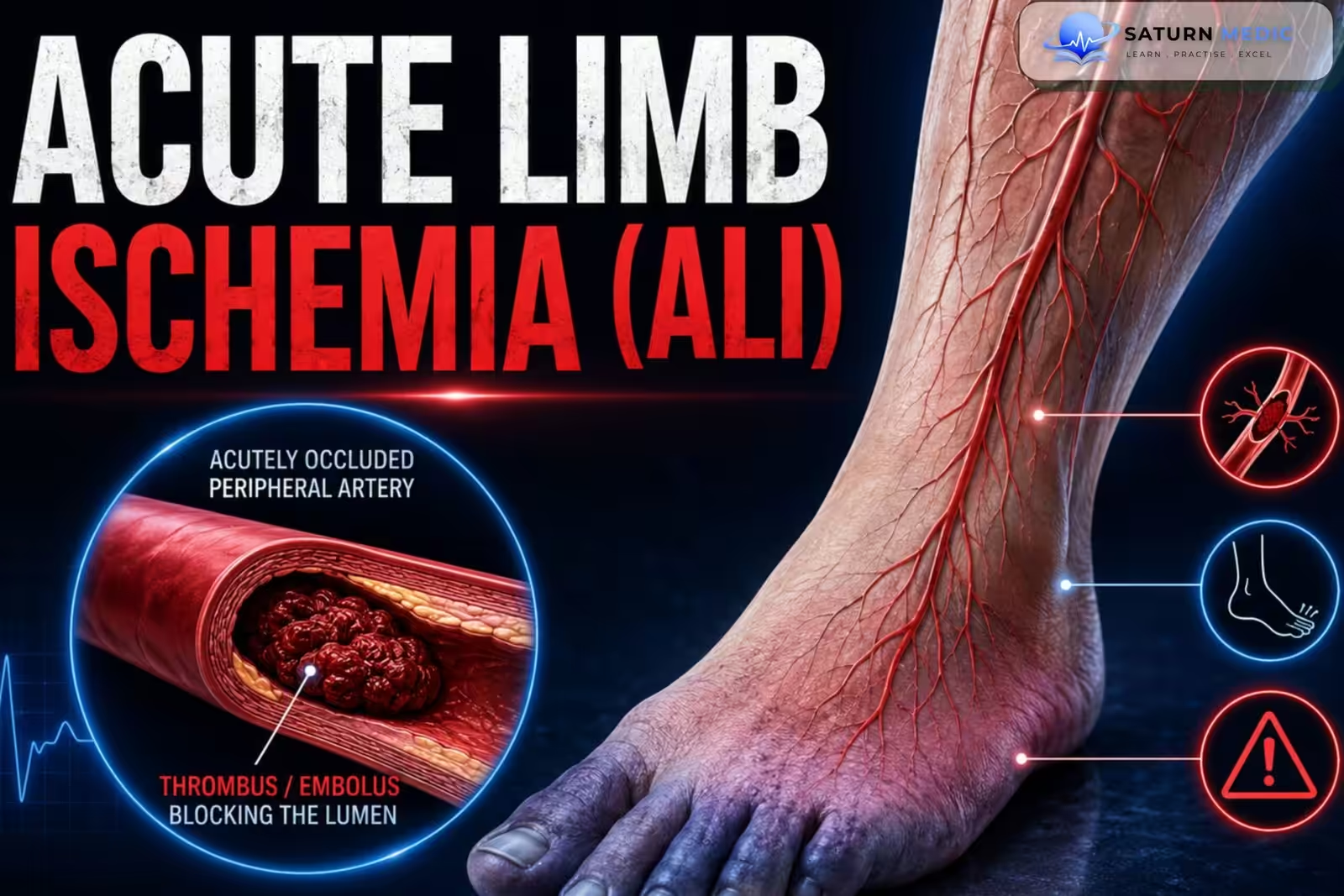
Acute limb ischemia (ALI) is a vascular emergency caused by a sudden reduction in arterial blood flow to a limb, leading to ischemia of less than 2 weeks’ duration. Without rapid treatment, it can result in permanent limb damage or amputation.
Teaching point
Patients with Acute Limb Ischemia (ALI) typically present with the 6 Ps:
Pain
Pallor
Pulselessness
Paresthesia
Paralysis
Poikilothermia (cold limb)
Etiology & Risk Factors
-Etiology for Acute Limb Ischemia (ALI)
- Arterial thrombosis (most common)
- Arterial embolism (especially from atrial fibrillation)
- Trauma or vascular injury
- Aortic dissection and other nonthromboembolic cause
–Risk Factors for Acute Limb Ischemia (ALI)
- Atherosclerosis
- Atrial fibrillation
- Recent myocardial infarction
- Previous vascular stent or graft
- Hypercoagulable states
- Trauma or recent arterial catheterization
Pathophysiology
- Sudden arterial occlusion (usually by thrombosis or embolism) causes an abrupt loss of blood flow to the limb.
- Reduced tissue perfusion leads to ischemia of muscles and nerves.
- Prolonged ischemia results in tissue necrosis, causing sensory and motor deficits and potentially irreversible limb damage if blood flow is not restored promptly.
Clinical Presentation
Patients with Acute Limb Ischemia (ALI) typically present with the 6 Ps:
- Pain (sudden, severe)
- Pallor
- Pulselessness
- Paresthesia
- Paralysis
- Poikilothermia (cold limb)
Important Note
Acute Limb Ischemia (ALI) is a vascular emergency. Severe pain suggests the limb is at risk, and treatment should not be delayed for imaging. Urgent vascular surgery assessment is required.
History Taking
- Was it sudden or gradual?
- Where is the pain?
- Is the pain severe?
- Have you noticed your limb becoming cold or pale?
- Do you have numbness or tingling?
- Do you have weakness or difficulty moving the limb?
- Have you had leg pain while walking (claudication) before this?
- Do you have a history of atrial fibrillation, heart attack, or peripheral arterial disease?
- Have you had any recent trauma or vascular procedure?
Physical Examination
- Inspect the limb for color (pallor/mottling).
- Assess temperature (cold limb).
- Palpate and compare distal pulses with the opposite limb.
- Check capillary refill.
- Assess sensation (paresthesia/sensory loss).
- Assess motor function (weakness or paralysis).
- Use a handheld Doppler to assess arterial blood flow if pulses are absent or reduced.
Investigations
- Handheld Doppler – best initial bedside test for Acute Limb Ischemia (ALI).
- Ankle–brachial index (ABI).
- CT angiography (CTA) – most common imaging to identify the site of occlusion.
- Duplex ultrasound or digital subtraction angiography (when indicated).
- Laboratory tests: CBC, coagulation profile, CMP, blood gas, serum lactate, CPK/myoglobin.
- ECG and echocardiography to identify a cardiac source of emboli.
Important: If the limb is clearly threatened, do not delay revascularization for imaging.
Diagnosis
-
Diagnosis is based on clinical suspicion and confirmation with bedside vascular assessment.
- Clinical diagnosis: Sudden onset of the 6 Ps (pain, pallor, pulselessness, paresthesia, paralysis, poikilothermia).
- Confirmatory bedside test: Handheld Doppler to assess arterial blood flow.
- Confirmatory imaging: CT angiography (CTA) is the most common imaging modality to identify the site of arterial occlusion.
Management
- Urgent vascular surgery consultation.
- Start IV unfractionated heparin as soon as possible (unless contraindicated).
- Provide analgesia and supportive care.
- Do not delay treatment for imaging if the limb is threatened.
- Revascularization (endovascular or surgical) for viable/threatened limbs.
- Amputation for a nonviable limb.
- Treat the underlying cause (e.g., atrial fibrillation, trauma, infective endocarditis).
Complications
- Permanent nerve damage (sensory loss, muscle weakness, paralysis)
- Irreversible tissue necrosis
- Limb loss (amputation) due to irreversible ischemia
- Reperfusion injury (postischemic syndrome) after restoration of blood flow
Prognosis
- Good if diagnosed and treated promptly with rapid restoration of blood flow.
- Delayed treatment increases the risk of permanent nerve damage, irreversible tissue necrosis, and limb loss (amputation).
- Prognosis depends on limb viability at presentation and the time to revascularization.
Key Points / Clinical Pearls
- Acute Limb Ischemia (ALI) is a vascular emergency.
- Think of the 6 Ps: Pain, Pallor, Pulselessness, Paresthesia, Paralysis, Poikilothermia.
- Handheld Doppler is the best initial bedside test; CTA is the common imaging test.
- Do not delay treatment for imaging if the limb is threatened.
- Start IV unfractionated heparin (unless contraindicated) and obtain urgent vascular surgery consultation.
- Early revascularization is essential to save the limb.
- Smith DA, Lilie CJ. National Center for Biotechnology Information (NIH). Acute Arterial Occlusion, StatPearls.
- Rutherford RB, Baker JD, Ernst C, et al. Recommended Standards for Reports Dealing With Lower Extremity Ischemia: Revised Version. J Vasc Surg. 1997;26:517-538. PMID: 9308598.
- Olinic DM, Stanek A, Tataru DA, et al. Acute Limb Ischemia: An Update on Diagnosis and Management. J Clin Med. 2019;8:1215. PMC6723825.
- Zemaitis MR, Boll JM, Kato M, Golla MSG. National Center for Biotechnology Information (NIH). Peripheral Arterial Disease, StatPearls.
- MedlinePlus, National Library of Medicine (NIH). Arterial Embolism: Medical Encyclopedia.