
The Focal Length Of A Convex Lens By Graphical Method
On This Page
-
IntroductionIntroduction
-
AimAim
-
ToolsTools
-
Steps & MethodsSteps & Methods
-
Parameters, Theory & Final LawParameters, Theory & Final Law
-
Medical ApplicationMedical Application
Introduction to the Focal Length of a Convex Lens by Graphical Method
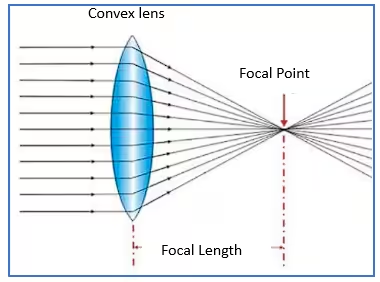
The focal length is the distance between the optical center of a lens and its focal point, where parallel rays of light converge after passing through the lens. A lens is a transparent optical device with curved surfaces that refracts light, and it is usually made of glass or plastic. There are two main types of lenses: convex and concave lenses. Determining the focal length of a convex lens by graphical method offers a particularly reliable way to measure this property, since it relies on multiple object-image distance pairs plotted on a graph rather than a single measurement, allowing small experimental errors to average out and producing a more statistically accurate result.
Aim of The Graphical Method Convex Lens Experiment
Determination of the Focal Length of a Convex Lens by the Graphical Method
Graphical Method Convex Lens Experiment: Tools
- Convex lens
- Meter scale
- Light source (lamp)
- White screen
- Object
- Two holders for the lens and object
Steps And Method of The Graphical Method Convex Lens Experiment
- Place the object pin between the lamp and the lens.
- Move the lens slowly away from the object until the sharpest image is formed on the screen.
- Record the object–lens distance and lens–screen distance.
- Increase the object distance by 3 cm, then move the lens until a sharp image is formed on the screen.
- Record the object and image distances. Repeat Step 3 at least five times.
- For each trial, change the screen position and move the lens until a sharp image is obtained.
Parameters, Theory And Final Law of The experiment
Parameters & Final Law
The focal length of the lens is:
Table of The Readings
|
Distance of object from lens U cm |
Distance of image from lens V cm |
1/U cm⁻¹ | 1/V cm⁻¹ |
|---|---|---|---|
Medical Application
Understanding the focal length of a convex lens by graphical method has direct clinical applications in ophthalmology.
This principle is used to diagnose and treat eye defects such as long sight (hyperopia) and short sight (myopia), where corrective lenses of a specific focal length restore proper image formation on the retina. It is also applied in diagnosing and treating astigmatism, a condition where irregular corneal curvature causes light to focus unevenly.
Beyond vision correction, the same focal length principles are fundamental to medical and biological imaging devices such as microscopes and endoscopes, where precisely calculated lens combinations determine magnification and image clarity.