Welcome to the Saturn Medic medical labs — an interactive space where you can explore Anatomy, Embryology, Histology, and Medical Physics through hands-on visuals instead of flipping through static PDFs. As the first Iraqi medical education platform, we built these medical labs for medical students and sixth-grade preparatory students preparing for university admissions, giving you a way to actually see and interact with the structures and processes you’re studying, not just read about them.
Click into any subject below to start exploring.
What’s Included in Our Medical Labs
Our medical labs currently cover four core subjects, each built around the way medical curricula are actually taught:
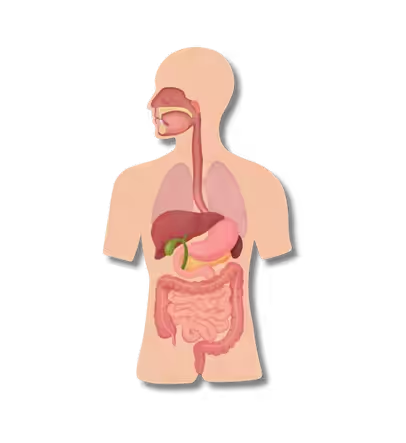
Anatomy — structure, form, and function, with interactive 3D models built using free, publicly available anatomical resources such as the NIH 3D Print Exchange, so you can rotate and explore real anatomical structures instead of relying on flat diagrams.
Embryology — growth and development, tracking how structures form and change across gestational stages, from early cell division through organ formation.
Histology — cells, tissues, and microscopy, covering the cellular architecture behind every organ system, the kind of detail that’s easy to skim past in a textbook but essential once you’re staring down a slide in an exam.
Medical Physics — principles and imaging, covering the physical concepts behind diagnostic tools and clinical techniques, from radiation and optics to circuits and fluid mechanics, framed specifically around their medical applications rather than physics in the abstract.
Why Practice in Our Medical Labs
Textbooks are good at explaining concepts. They’re not always good at helping you see them. Anatomy is inherently three-dimensional, embryological development is a process unfolding over time, histology is about recognizing patterns under a microscope, and physics principles click faster when you can watch them play out rather than read a paragraph about them.
That’s the gap our medical labs are built to close. Instead of static scans or a single flat image, each subject gives you interactive tools — rotating 3D models, structured walkthroughs, and guided explanations — designed to build the kind of visual, spatial understanding that sticks with you past the exam and into clinical years.
Working through the labs alongside our question bank also reinforces the same material two different ways: the labs build your visual and conceptual understanding, while the question bank tests whether that understanding holds up under exam-style pressure. Students who move between both tend to retain material longer than those relying on one study method alone.
How to Use the Medical Labs
Choose a subject card above — Anatomy, Embryology, Histology, or Medical Physics — to enter that lab. Each subject is organized into topics or regions so you can go straight to what you’re currently studying instead of working through everything at once. New content and models are added regularly as each subject continues to expand.