

Clinical Subject Page
Acute Coronary Syndrome (ACS)
Commonly known as a heart attack — irreversible necrosis of myocardial tissue caused by prolonged ischemia, most often due to occlusion of a coronary artery.
Also called
ICD-10
Specialty
Onset
Reviewed
-
OverviewOverview
-
Etiology & Risk FactorsEtiology & Risk Factors
-
PathophysiologyPathophysiology
-
Clinical PresentationClinical Presentation
-
History TakingHistory Taking
-
Physical ExaminationPhysical Examination
-
InvestigationsInvestigations
-
DiagnosisDiagnosis
-
ManagementManagement
-
ComplicationsComplications
-
PrognosisPrognosis
-
Key Points / Clinical PearlsKey Points / Clinical Pearls
Overview
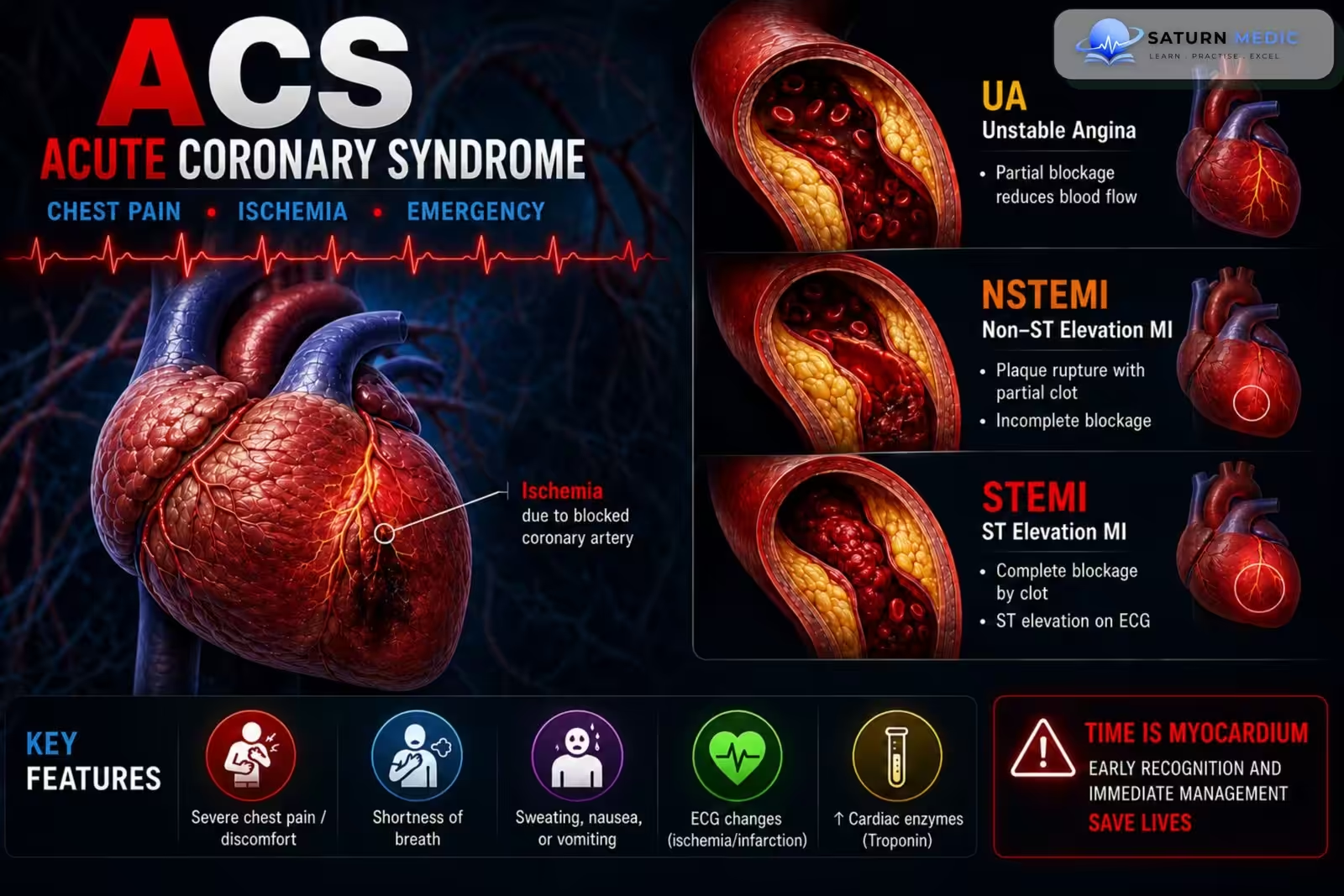
Acute coronary syndrome (ACS) is a group of conditions caused by acute myocardial ischemia resulting from partial or complete occlusion of a coronary artery.
Acute coronary syndrome (ACS) Includes :
• Unstable Angina (UA)
• Non-ST-Segment Elevation Myocardial Infarction (NSTEMI)
• ST-Segment Elevation Myocardial Infarction (STEMI)
Etiology & Risk Factors
-Main Cause of Acute Coronary Syndrome (ACS)
- Acute partial or complete coronary artery occlusion
- Reduced coronary blood flow causes myocardial ischemia
-Types of Acute Coronary Syndrome (ACS)
- Partial occlusion → Unstable Angina or NSTEMI
- Complete occlusion → STEMI
Pathophysiology
Mechanism:
Coronary Artery Occlusion
↓
Reduced Myocardial Blood Supply
↓
Myocardial Ischemia
↓
Acute coronary syndrome (ACS).
| ACS Type | Coronary Artery Status | Pathophysiological Mechanism | Myocardial Involvement | Troponin |
|---|---|---|---|---|
| Unstable Angina (UA) | Partial coronary artery occlusion | Reduced coronary blood flow causes myocardial ischemia without infarction | No myocardial necrosis/infarction | Normal |
| NSTEMI | Usually partial coronary artery occlusion | Acute myocardial ischemia leading to infarction of the inner myocardial layer | Subendocardial infarction | Elevated |
| STEMI | Usually complete coronary artery occlusion | Complete interruption of blood flow causing extensive myocardial infarction | Transmural infarction (full-thickness myocardium) | Elevated |
Clinical Presentation
Symptoms Of Acute coronary syndrome (ACS)
- • Acute retrosternal chest pain
- • Dull pressure or chest tightness
- • Angina at rest
- • Angina with minimal exertion
- • Persistent or worsening (crescendo) angina
- • Usually not relieved by rest
Anginal Equivalents–>Shortness of breath
Associated Symptoms
- • Diaphoresis (sweating)
- • Nausea
- • Vomiting
- • Palpitations
- • Syncope
History Taking
Diagnosis rests on the combination of clinical history, ECG findings, and cardiac biomarkers.
Key Questions
- Character of chest pain
- Onset and duration
- Radiation
- Presence at rest or with exertion
- Previous episodes
- Response to nitroglycerin
- Associated dyspnea
- Nausea or vomiting
- Syncope
- Palpitations
Red Flags
- Hemodynamic instability
- Acute pulmonary edema
- Tachyarrhythmias
- Bradyarrhythmia
- Cardiogenic shock
Physical Examination
General Examination
• Assess using the ABCDE approach.
Look For
• Signs of hemodynamic instability
• Signs of cardiogenic shock
• Pulmonary edema
• Arrhythmias
Monitoring
• Continuous telemetry
• Pulse oximetry
Long-term secondary prevention typically includes dual antiplatelet therapy, a high-intensity statin, a beta-blocker, an ACE inhibitor or ARB (especially with reduced ejection fraction), and structured cardiac rehabilitation.
Investigations
-Essential Tests
ECG
- Immediate 12-lead ECG
Cardiac Biomarkers
- Cardiac troponin (cTn)
- Serial troponin measurements
Laboratory Tests
- CBC
- BMP
- BNP or NT-proBNP
- Coagulation panel
- Lipid profile
Monitoring
- • Serial ECGs
- • Continuous cardiac monitoring
Diagnosis
–Diagnostic Criteria For Acute coronary syndrome (ACS):
-STEMI
ST-segment elevation in two contiguous leads or new LBBB
- Elevated troponin
-NSTEMI
- No ST-segment elevation
- Elevated troponin
-Unstable Angina
- • No ST-segment elevation
- • Normal troponin
Management of Acute coronary syndrome (ACS)
Initial Management for All ACS Patients
Monitoring
- Continuous telemetry
- Serial ECGs
- Serial troponins
Oxygen
- Supplement oxygen as needed to maintain saturation ≥ 90%
Antiplatelet Therapy
- Aspirin
- P2Y12 inhibitor
- Dual antiplatelet therapy (DAPT)
Anticoagulation
- Parenteral anticoagulation (e.g., UFH)
Additional Medical Therapy
- Statins
- Beta blockers
- RAAS inhibitors
- • Analgesia for chest pain
MONA-BASH Mnemonic
| Letter | Therapy |
|---|---|
| M | Morphine |
| O | Oxygen |
| N | Nitroglycerin |
| A | Antiplatelet drugs |
| B | Beta blockers |
| A | ACE inhibitors |
| S | Statins |
| H | Heparin |
-Revascularization
STEMI
- Immediate revascularization
- Preferred: Primary PCI
- Fibrinolytic therapy if timely PCI unavailable
-NSTE-ACS
- Timing determined by risk stratification
- Cardiology consultation required
–PCI
- Preferred revascularization strategy
- Balloon dilation with stent implantation
-CABG (Selected Cases)
- Large myocardium at risk
- Cardiogenic shock
- Hemodynamic instability
- Unsuccessful PCI
- Coronary anatomy unsuitable for PCI
- Mechanical complications
Complications of Acute coronary syndrome (ACS)
Serious Complications
- Cardiogenic shock
- Acute heart failure
- Acute pulmonary edema
- Ventricular tachycardia (VT)
- Ventricular fibrillation (VF)
- Complete heart block
Mechanical Complications
- Papillary muscle rupture
- Ventricular septal rupture
Prognosis of Acute coronary syndrome (ACS)
ACS subtype
- Extent of myocardial injury
- Presence of cardiogenic shock
- Success and timing of revascularization
- Hemodynamic stability
Key Points / Clinical Pearls of Acute coronary syndrome (ACS)
- • ACS includes unstable angina, NSTEMI, and STEMI.
- • Troponin differentiates MI from unstable angina.
- • ECG differentiates STEMI from NSTEMI.
- • STEMI usually results from complete coronary occlusion and requires immediate revascularization.
- • NSTEMI and unstable angina are usually caused by partial coronary occlusion.
- • Initial evaluation should include 12-lead ECG and cardiac troponin.
- • Core therapies include DAPT, anticoagulation, statins, beta blockers, and RAAS inhibitors.
- • PCI is the preferred revascularization strategy.
- • Watch closely for cardiogenic shock, pulmonary edema, and life-threatening arrhythmias.
- National Center for Biotechnology Information (NIH). Acute Coronary Syndrome, StatPearls.
- Rao SV, O'Donoghue ML, Ruel M, et al. 2025 ACC/AHA/ACEP/NAEMSP/SCAI Guideline for the Management of Patients With Acute Coronary Syndromes. Circulation. 2025;151:e771-e862. doi: 10.1161/CIR.0000000000001309.
- MedlinePlus, National Library of Medicine (NIH). Acute Coronary Syndrome: Health Topic.
- National Center for Biotechnology Information (NIH). Selecting a Treatment Modality in Acute Coronary Syndrome, StatPearls.
- National Center for Biotechnology Information (NIH). Unstable Angina, StatPearls.