

Clinical Subject Page
Patent Ductus Arteriosus (PDA)
ICD-10
Specialty
Onset
Reviewed
-
OverviewOverview
-
Etiology & Risk FactorsEtiology & Risk Factors
-
PathophysiologyPathophysiology
-
Clinical PresentationClinical Presentation
-
History TakingHistory Taking
-
InvestigationsInvestigations
-
DiagnosisDiagnosis
-
ManagementManagement
-
ComplicationsComplications
-
PrognosisPrognosis
-
Key Points / Clinical PearlsKey Points / Clinical Pearls
Overview
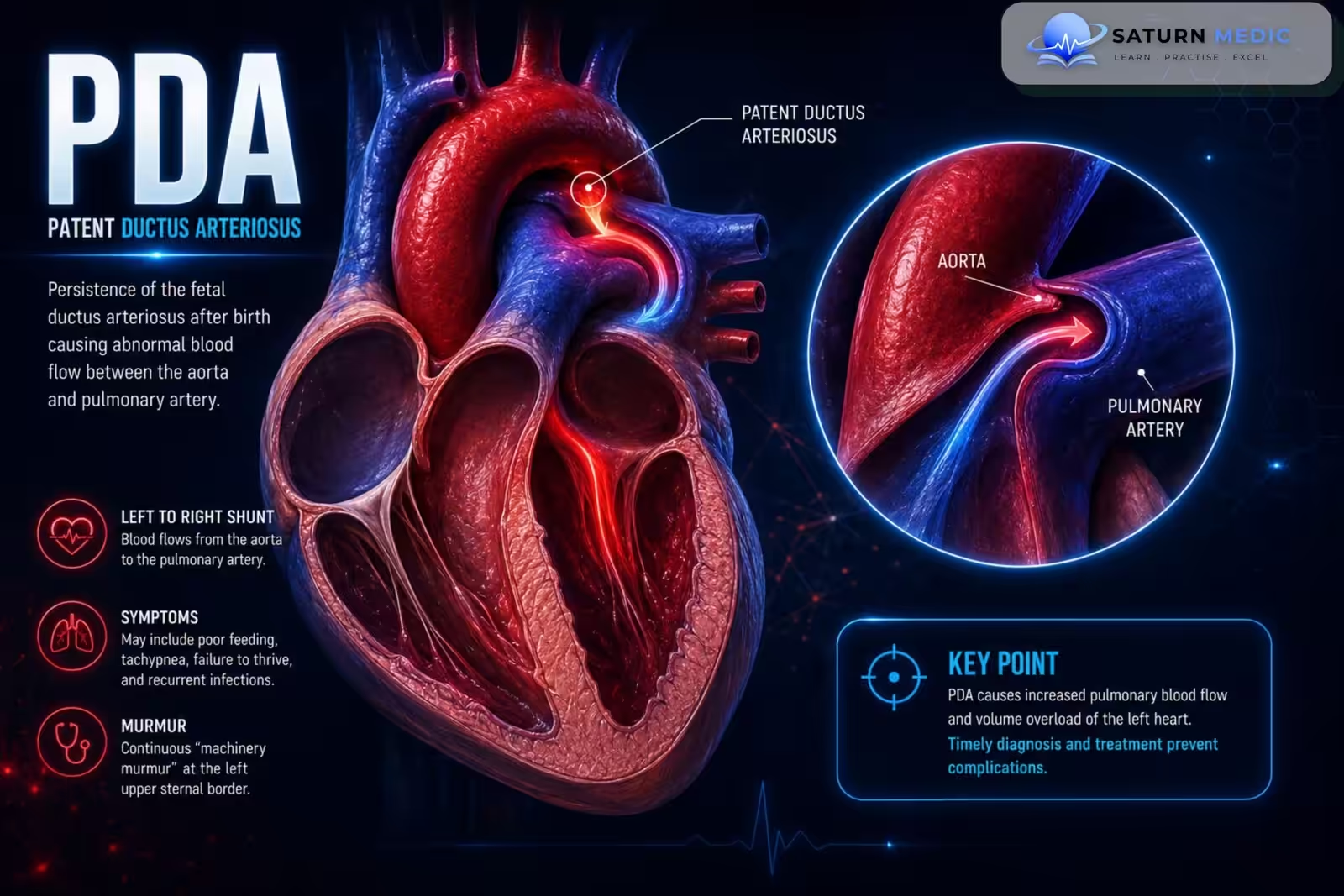
Patent Ductus Arteriosus (PDA) is the Failure of the ductus arteriosus to completely close after birth
Etiology & Risk Factors
- – Usually sporadic
– Associated genetic disorders:
– DiGeorge syndrome
– Down syndrome
– Maternal exposures:
– Alcohol consumption
– Phenylketonuria
– Diabetes
Pathophysiology
- – In fetal life, the ductus arteriosus provides a normal right-to-left shunt and remains patent because
of prostaglandins and low oxygen tension.
– After birth:
– Pulmonary vascular resistance decreases.
– Shunt reverses from right-to-left to left-to-right.
– Failure of ductal closure causes:
– Persistent communication between the aorta and pulmonary artery.
– Left-to-right shunt.
– Pulmonary volume overload.
– Continuous right ventricular and/or left ventricular strain.
– Heart failure.
– Patent Ductus Arteriosus (PDA) is essential for survival in some ductal-dependent congenital heart defects (e.g., Tetralogy of
Fallot, Transposition of the Great Arteries). - Long-standing disease may result in Eisenmenger syndrome with shunt reversal and differential cyanosis.
Clinical Presentation
- General
– Mild TOF:
– May be asymptomatic initially.
– Symptoms of heart failure may develop after 4–6 weeks.
– Cyanosis:
– Severity depends on RVOTO.
– Mild obstruction:
– Minimal cyanosis (“Pink Tet”).
– Severe obstruction:
– Marked cyanosis present from birth.
Tet Spells (Hypercyanotic Spells)
Peak incidence: - 2–4 months of age.
– Triggered by:
– Crying
– Feeding
– Defecation
History Taking
Assess for:
– Prematurity.
– Feeding difficulty.
– Failure to thrive.
– Tachypnea.
– Sweating during feeding.
– Recurrent respiratory infections.
– Exercise intolerance.
– Symptoms of heart failure.
– History suggestive of pulmonary hypertension.
Investigations
Echocardiography (Confirmatory Test)
– Confirmatory investigation in infants.
– Assesses:
– Shunt volume.
– Pulmonary artery pressure.
– Left atrial enlargement.
– Left ventricular enlargement.
– Color Doppler demonstrates blood flow from the aorta into the pulmonary artery.
ECG
Small PDA:
– Usually normal.
Large PDA:
– Left axis deviation due to left ventricular hypertrophy.
– Right ventricular hypertrophy if pulmonary hypertension develops.
Chest X-ray
– Prominent pulmonary artery.
– Prominent aortic knob.
– Increased pulmonary vascular markings.
Pulse Oximetry
– Peripheral hypoxemia in the feet may occur with right-to-left shunting
Diagnosis
Diagnosis is confirmed by:
– Transthoracic echocardiography with Doppler.
Supportive investigations:
– ECG.
– Chest X-ray.
– Pulse oximetry.
– Cardiac CT/MRI.
– Cardiac catheterization when indicated.
Management
- General Principles : Refer all patients to a congenital cardiac center.
- Management depends on: –
- Size of Patent Ductus Arteriosus (PDA).
- Magnitude of left-to-right shunt.
- Age. – Weight. – Assess for associated complications such as intestinal ischemia and Eisenmenger syndrome.
- Pharmacological Closure (Premature Infants) Indications:
- Birth weight <1 kg requiring mechanical ventilation.
- Birth weight >1 kg with symptomatic PDA (heart failure or respiratory distress).
- Contraindications: – Ductal-dependent congenital heart disease.
- Persistent pulmonary hypertension of the newborn.
- Oliguria.
- Thrombocytopenia.
- Recent cerebral, intestinal, or pulmonary hemorrhage.
- Necrotizing enterocolitis.
- Treatment: Indomethacin & Ibuprofen.
Complications
- Heart failure during infancy.
- Infective endocarditis.
- Pulmonary hypertension.
- Eisenmenger syndrome.
- Differential cyanosis.
Prognosis
- – Prognosis is excellent after successful closure.
– Untreated large Patent Ductus Arteriosus (PDA) may progress to pulmonary hypertension and Eisenmenger syndrome.
– Patent Ductus Arteriosus (PDA) closure is contraindicated when pulmonary hypertension has resulted in right-to-left shunting
or when the Patent Ductus Arteriosus (PDA) is required for survival in ductal-dependent congenital heart disease.
Key Points / Clinical Pearls
- – Patent Ductus Arteriosus (PDA) is one of the three most common acyanotic congenital heart defects.
– Prematurity is the strongest risk factor.
– Classic murmur: continuous “machinery” murmur in the left infraclavicular region.
– Confirmatory test: transthoracic echocardiography with Doppler.
– Indomethacin and ibuprofen close Patent Ductus Arteriosus (PDA) by inhibiting prostaglandin synthesis.
– Prostaglandin E1 is used to keep the ductus arteriosus open in ductal-dependent congenital heart
disease.
– Close significant Patent Ductus Arteriosus (PDA) before irreversible pulmonary hypertension develops.
– Differential cyanosis suggests Eisenmenger syndrome with shunt reversal.
- Gillam-Krakauer M, Mahajan K. National Center for Biotechnology Information (NIH). Patent Ductus Arteriosus, StatPearls.
- 2025 ACC/AHA/HRS/ISACHD/SCAI Guideline for the Management of Adults With Congenital Heart Disease. Circulation. 2025. doi: 10.1161/CIR.0000000000001402.
- Kritzmire SM, Boyer TJ, Singh P. National Center for Biotechnology Information (NIH). Anesthesia for Patients With Patent Ductus Arteriosus, StatPearls.
- MedlinePlus, National Library of Medicine (NIH). Patent Ductus Arteriosus: Medical Encyclopedia.
- Basit H, Wallen TJ, Sergent BN. National Center for Biotechnology Information (NIH). Eisenmenger Syndrome, StatPearls.