

Clinical Subject Page
Myocarditis
Also called
ICD-10
Specialty
Onset
Reviewed
-
OverviewOverview
-
Etiology & Risk FactorsEtiology & Risk Factors
-
PathophysiologyPathophysiology
-
Clinical PresentationClinical Presentation
-
History TakingHistory Taking
-
InvestigationsInvestigations
-
DiagnosisDiagnosis
-
ManagementManagement
-
ComplicationsComplications
-
PrognosisPrognosis
-
Key Points / Clinical PearlsKey Points / Clinical Pearls
Overview
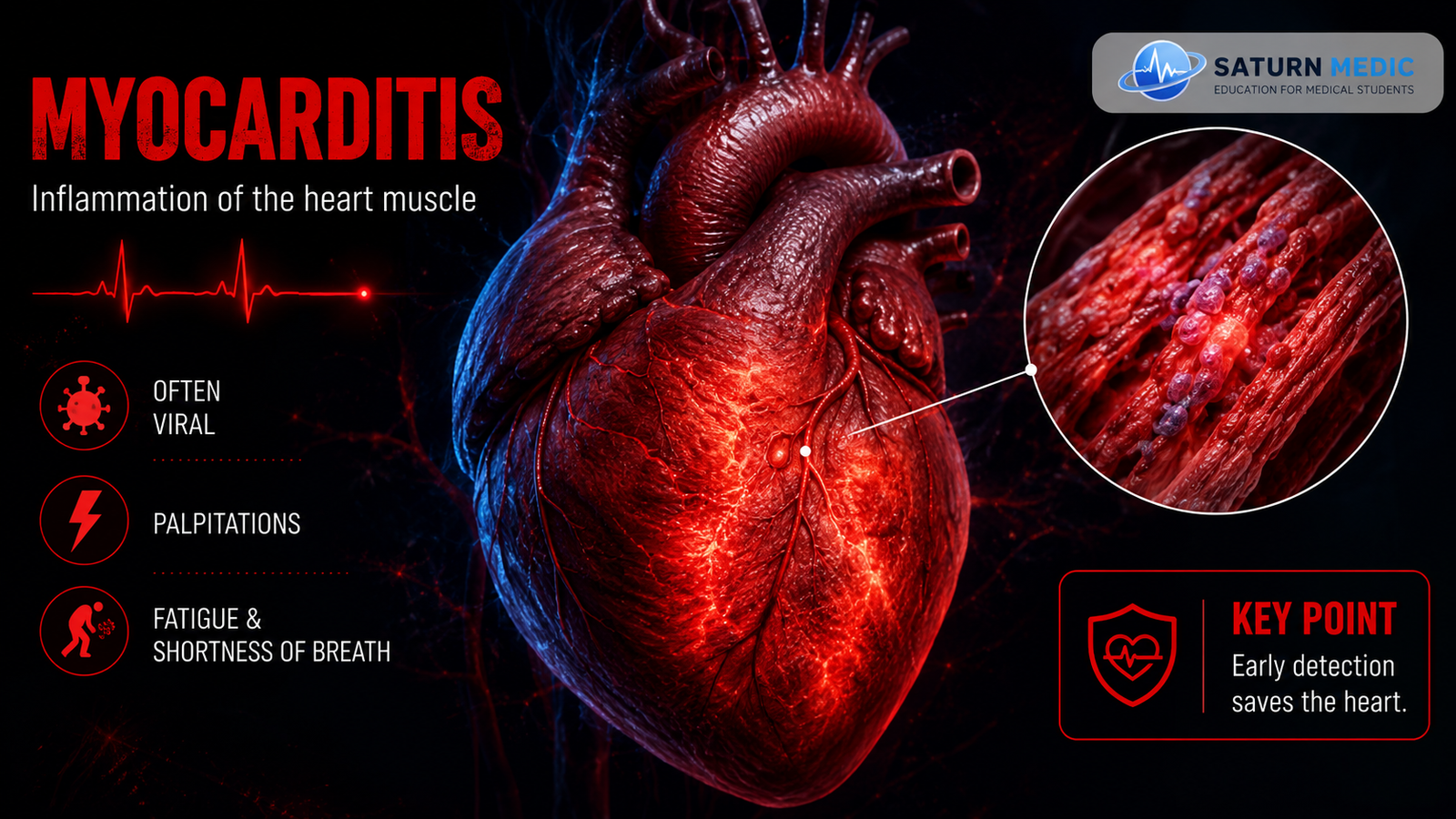
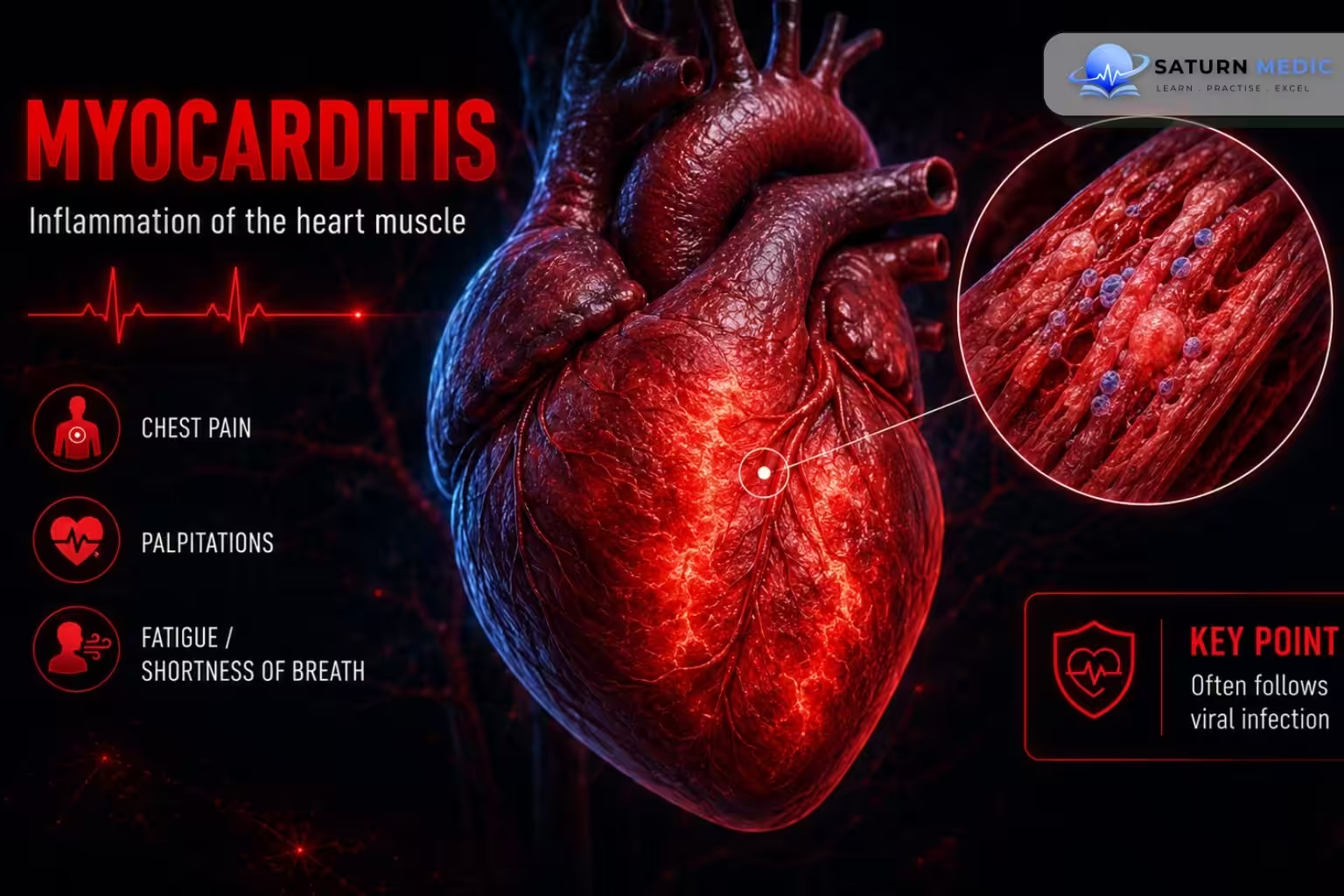
Myocarditis is an inflammatory disease of the myocardium characterized by myocardial injury due to infectious or noninfectious causes.
Viral infections are the most common cause, although autoimmune diseases, medications, toxins, and other inflammatory conditions may also be responsible.
it can impair cardiac contractility and electrical conduction, resulting in a wide spectrum of presentations ranging from asymptomatic disease to chest pain, arrhythmias, acute heart failure, and, in severe cases, fulminant myocarditis with cardiogenic shock.
Etiology & Risk Factors
Etiology
Viral infections (most common): The leading cause in developed countries; commonly associated with enteroviruses, adenovirus, parvovirus B19, human herpesvirus 6 (HHV-6), influenza viruses, and SARS-CoV-2.
Bacterial infections: Less common; may occur secondary to pathogens such as Corynebacterium diphtheriae, Borrelia burgdorferi (Lyme disease), Mycoplasma pneumoniae, and other bacterial infections.
Autoimmune and inflammatory diseases: Includes systemic lupus erythematosus (SLE), rheumatoid arthritis, systemic vasculitides, inflammatory bowel disease, and other immune-mediated disorders.
Drug-induced hypersensitivity myocarditis: May develop as an immune-mediated reaction to medications, including immune checkpoint inhibitors, certain antibiotics, anticonvulsants, and other drugs.
Toxin-related myocarditis: Caused by exposure to alcohol, cocaine, amphetamines, heavy metals, radiation, or other cardiotoxic agents.
Giant cell myocarditis: A rare but highly aggressive autoimmune form characterized by rapidly progressive heart failure and malignant ventricular arrhythmias.
Cardiac sarcoidosis: Granulomatous myocardial inflammation that may present with conduction abnormalities, ventricular arrhythmias, or heart failure.
Risk Factors
Recent viral infection, particularly involving the respiratory or gastrointestinal tract.
Pre-existing autoimmune or systemic inflammatory disease.
Immunosuppression, including HIV infection, malignancy, or immunosuppressive therapy.
Young age, particularly adolescents and young adults, who are more commonly affected.
Exposure to cardiotoxic medications or recreational drugs, including chemotherapy agents and cocaine.
Family history of autoimmune disorders or inherited susceptibility to immune-mediated diseases.
Male sex, which is associated with a higher incidence of myocarditis, particularly viral myocarditis.
Pathophysiology
Viral infection / Autoimmune injury
↓
Myocardial inflammation
↓
Myocyte injury & necrosis
↓
↓ Myocardial contractility
↓
LV systolic dysfunction
↓
Heart failure + Arrhythmias
↓
Dilated cardiomyopathy (chronic cases)
Clinical Presentation
Symptoms
- Chest pain
- Dyspnea
- Fatigue
- Palpitations
- Syncope
- Fever
- Recent viral illness
Signs
- Tachycardia
- S3 gallop
- Signs of heart failure
- Arrhythmias
- Hypotension (severe cases)
History Taking
Key Questions
- Recent viral illness?
- Chest pain?
- Shortness of breath?
- Palpitations?
- Syncope?
- Fever?
- Autoimmune disease?
- New medications?
- Toxin exposure?
Red Flags
- Cardiogenic shock
- Sustained ventricular arrhythmias
- Syncope
- Acute heart failure
- Sudden cardiac arrest
Investigations
Laboratory
CBC
CRP/ESR
Troponin
BNP/NT-proBNP
Viral studies (selected patients)
ECG
Sinus tachycardia
ST-T changes
Arrhythmias
AV block
Imaging
Echocardiography
Cardiac MRI (preferred non-invasive test)
Chest X-ray
Additional Tests
Endomyocardial biopsy (gold standard in selected patients)
Coronary angiography (to exclude ACS)
Diagnosis
Diagnosis is based on:
- Clinical suspicion
- Elevated cardiac biomarkers
- ECG abnormalities
- Cardiac MRI findings
- Endomyocardial biopsy in selected cases
Management
Supportive Care
Rest and activity restriction
Treat heart failure if present
Manage arrhythmias
Medications
ACE inhibitor/ARB/ARNI
β-blocker (when stable)
Diuretics
MRA
Immunosuppressive therapy (selected autoimmune cases)
Advanced Therapy
Mechanical circulatory support
Heart transplantation (for fulminant type)
Complications
- Heart failure
- Dilated cardiomyopathy
- Ventricular arrhythmias
- AV block
- Cardiogenic shock
- Sudden cardiac death
Prognosis
- Many patients recover completely.
- Fulminant myocarditis requires urgent treatment but may recover with appropriate support.
- Persistent inflammation may progress to dilated cardiomyopathy.
- Prognosis depends on the cause and severity.
Key Points / Clinical Pearls
- Suspect in young patients with:
- New-onset chest pain
- Arrhythmias
- Heart failure
- Recent viral illness
- Few or no atherosclerotic cardiovascular disease risk factors
- Clinical presentation ranges from:
- Asymptomatic disease
- Mild symptoms
- Fulminant myocarditis with cardiogenic shock and life-threatening arrhythmias
- High-risk features:
- Symptomatic heart failure
- Ventricular arrhythmias
- High-grade AV block (heart block)
- Fulminant myocarditis is characterized by:
- Hemodynamic instability (cardiogenic shock)
- Electrical instability (ventricular tachycardia, high-grade AV block)
- Admit all patients with suspected myocarditis to the hospital.
- Obtain early cardiology and/or critical care consultation for high-risk patients.
- Initial diagnostic evaluation:
- 12-lead ECG
- Cardiac biomarkers (high-sensitivity troponin)
- Inflammatory markers
- Transthoracic echocardiography (TTE)
- Shams P, Collier SA. National Center for Biotechnology Information (NIH). Acute Myocarditis, StatPearls.
- Kociol RD, Cooper LT, Fang JC, et al. 2024 ACC Expert Consensus Decision Pathway on Strategies and Criteria for the Diagnosis and Management of Myocarditis. J Am Coll Cardiol. 2024. doi: 10.1016/j.jacc.2024.10.080.
- Kang M, Chippa V, An J. National Center for Biotechnology Information (NIH). Viral Myocarditis, StatPearls.
- Law YM, Lal AK, Chen S, et al; American Heart Association Pediatric Heart Failure and Transplantation Committee. Diagnosis and Management of Myocarditis in Children: A Scientific Statement From the American Heart Association. Circulation. 2021;144:e123-e135. PMID: 34229446.
- MedlinePlus, National Library of Medicine (NIH). Myocarditis: Medical Encyclopedia.