
Saturn Medic

Clinical Subject Page

Hospital-Acquired Pneumonia (HAP)

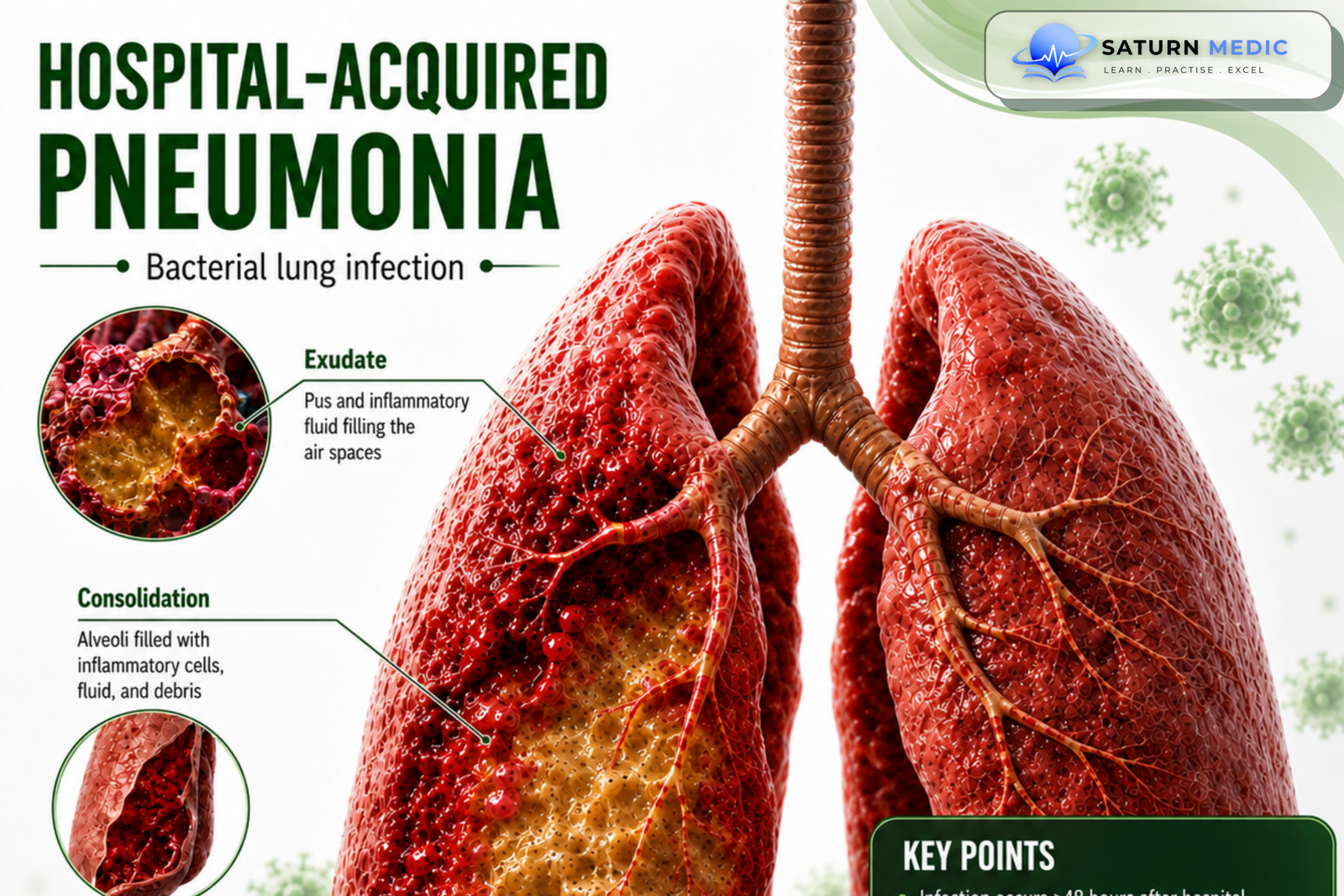
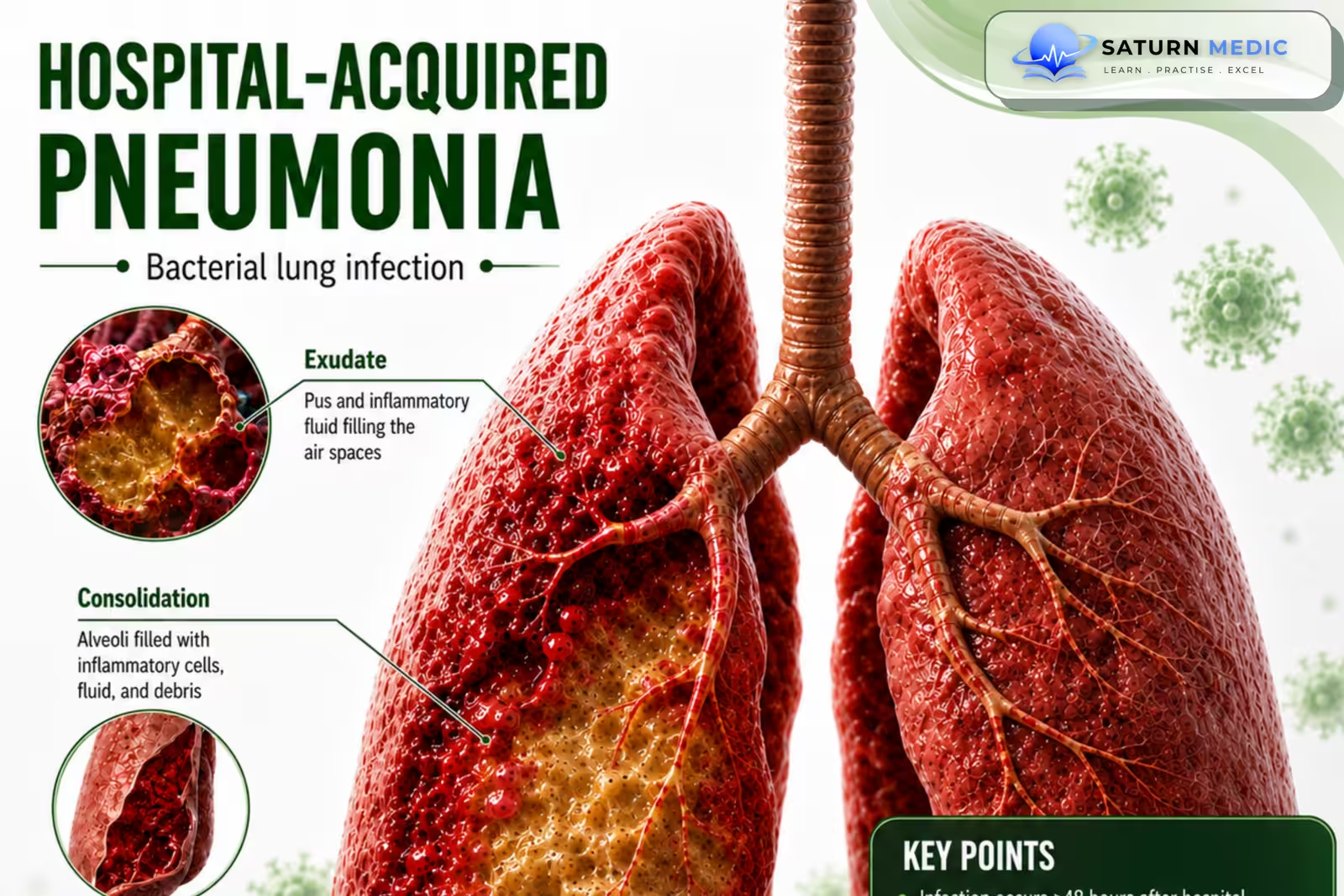
Hospital-acquired pneumonia (HAP) is an acute infection of the lung parenchyma that develops 48 hours or more after hospital admission and was not present or incubating at the time of admission.

Also called

Nosocomial pneumonia

ICD-10

J67.9

Specialty

Pulmonology

Onset

Acute

Reviewed

July 2026

On This Page

Overview

Hospital-acquired pneumonia (HAP) occurs when hospitalized patients develop a new lung infection, often caused by more resistant organisms than those causing community-acquired pneumonia.

It develops through:

Hospital exposure → Colonization with pathogenic organisms → Entry into lower airways → Lung infection

Hospital-acquired pneumonia (HAP) is an important cause of:

  • Prolonged hospitalization
  • Respiratory failure
  • Sepsis
  • Increased mortality

Etiology & Risk Factors

Common Causes of Hospital-Acquired Pneumonia (HAP)

Gram-Negative Bacteria

  • Pseudomonas aeruginosa
  • Klebsiella pneumoniae
  • Escherichia coli
  • Enterobacter species
  • Acinetobacter species

Gram-Positive Bacteria

  • Staphylococcus aureus
  • Methicillin-resistant Staphylococcus aureus (MRSA)

Risk Factors For Hospital-Acquired Pneumonia (HAP)

  • Prolonged hospitalization
  • Previous antibiotic use
  • Severe underlying illness
  • Advanced age
  • Chronic lung disease
  • Immunosuppression
  • Impaired consciousness
  • Aspiration risk
  • Recent surgery
  • Poor mobility

Risk Factors for Resistant Organisms

  • Previous intravenous antibiotic exposure
  • Prolonged hospital stay
  • Previous colonization with resistant bacteria
  • High local antimicrobial resistance

Important Note

Previous antibiotic exposure is an important risk factor for multidrug-resistant organisms Causing Hospital-Acquired Pneumonia (HAP).

Pathophysiology

Hospitalization

Colonization of the upper airway with pathogenic bacteria

Microaspiration into the lower respiratory tract

Failure of normal lung defenses

Bacterial multiplication in the alveoli

Immune and inflammatory response

Alveolar inflammation and exudate

Consolidation

Impaired gas exchange

Hypoxemia + Respiratory symptoms

Key Concept

Microaspiration of colonized upper airway secretions is a major mechanism in Hospital-Acquired Pneumonia (HAP).

Clinical Presentation

  • Symptoms

    • New or worsening cough
    • Purulent sputum
    • Dyspnea
    • Fever
    • Chills
    • Pleuritic chest pain

    Signs

    • Fever or hypothermia
    • Tachypnea
    • Tachycardia
    • Reduced oxygen saturation
    • Increased oxygen requirement

    Chest Signs

    • Crackles
    • Bronchial breathing
    • Reduced air entry
    • Dullness to percussion

    Severe Disease

    • Respiratory distress
    • Hypotension
    • Altered mental status
    • Severe hypoxemia
    • Signs of sepsis

History Taking

  • Ask about:

    • New or worsening cough?
    • Purulent sputum?
    • Shortness of breath?
    • Fever or chills?
    • Pleuritic chest pain?
    • When did symptoms start?
    • How long has the patient been hospitalized?
    • Recent antibiotic use?
    • Previous resistant organisms?
    • Previous MRSA or Pseudomonas infection?
    • Aspiration risk?

Physical Examination

Look for:

  • Fever or hypothermia
  • Tachypnea
  • Tachycardia
  • Hypotension
  • Confusion
  • Cyanosis
  • Reduced oxygen saturation

Chest Examination

Look for:

  • Crackles
  • Bronchial breathing
  • Reduced breath sounds
  • Dullness to percussion

Assess Severity

Look for:

  • Respiratory distress
  • Increasing oxygen requirement
  • Severe hypoxemia
  • Hemodynamic instability
  • Altered mental status
  • Signs of sepsis

Investigations of Hospital-Acquired Pneumonia (HAP)

  • Chest Imaging — Key Investigation For Hospital-Acquired Pneumonia (HAP)

    Chest X-ray

    May show:

    • New pulmonary infiltrate
    • Consolidation
    • Multifocal infiltrates
    • Pleural effusion

    CT Chest

    Consider when:

    • Chest X-ray is unclear
    • Complications are suspected
    • Alternative diagnoses are being considered

    Microbiological Tests

    Obtain when possible:

    • Sputum Gram stain and culture
    • Respiratory secretion culture
    • Blood cultures in severe disease

    Microbiological results help guide antibiotic de-escalation.

    Blood Tests

    • CBC
    • Renal function
    • Electrolytes
    • Liver function
    • Inflammatory markers
    • Serum lactate in severe disease

    Oxygen Assessment

    • Pulse oximetry
    • Arterial blood gas in severe hypoxemia or respiratory failure

Types of Pneumonias

CAP vs HAP vs Chemical Pneumonitis · Overview

Community-Acquired
Pneumonia (CAP)
Outside hospital or <48h of admission
Hospital-Acquired
Pneumonia (HAP)
≥48h after hospital admission
Chemical
Pneumonitis
Non-infectious lung injury
Definition
Lung infection acquired outside hospital or within 48h of admission, in a non-healthcare resident
Lung infection developing ≥48 hours after hospital admission, including ventilator-associated pneumonia (VAP)
Non-infectious lung injury from inhalation or aspiration of chemical irritants — no bacteria involved initially
Common causes
S. pneumoniae H. influenzae Atypicals
Mycoplasma, Chlamydophila, Legionella — especially in younger patients. Viruses (influenza, COVID-19) increasingly common.
Gram-negative bacilli P. aeruginosa MRSA
Klebsiella, Acinetobacter, Enterobacter. Often multidrug-resistant (MDR) organisms.
Gastric acid Toxic gases Hydrocarbons
Aspiration of gastric contents (Mendelson's syndrome), smoke inhalation, chemical fumes, petroleum products.
Typical patient
Any age. Risk ↑ with: age >65, smoking, COPD, asplenia, immunosuppression, alcoholism
ICU patients, ventilated patients, post-surgery, prolonged hospitalisation, immunocompromised
Reduced consciousness (anaesthesia, seizures, alcohol intoxication), GERD, dysphagia, occupational chemical exposure
Onset
Acute — hours to days; fever, productive cough, pleuritic chest pain
Variable — often more insidious; may be masked by underlying illness or sedation in ICU
Rapid — symptoms within 1–6 hours of exposure; acute dyspnea, cough, bronchospasm

CAP vs HAP vs Chemical Pneumonitis · Management & Prognosis

Community-Acquired
Pneumonia (CAP)
Outside hospital or <48h of admission
Hospital-Acquired
Pneumonia (HAP)
≥48h after hospital admission
Chemical
Pneumonitis
Non-infectious lung injury
Severity score
CURB-65 — score 0–5; guides home vs hospital vs ICU disposition
CPIS score — Clinical Pulmonary Infection Score; uses temperature, WBC, secretions, oxygenation, CXR
PaO₂/FiO₂ ratio — severity of hypoxia; ARDS criteria if <300 with bilateral infiltrates
Treatment
Mild: Amoxicillin 500mg TDS oral
Moderate: Amoxicillin + Clarithromycin
Severe: Co-amoxiclav IV + Clarithromycin IV
Duration: 5–7 days (severe: 7–10)
Broad-spectrum IV: Pip-tazo or Meropenem
+ MRSA cover (Vancomycin / Linezolid) if risk factors
Duration: 7–8 days. De-escalate based on cultures.
Supportive: O₂, bronchodilators, NIV/intubation if needed
Corticosteroids — consider in severe cases
Antibiotics NOT given initially — add only if secondary bacterial infection develops
Remove source of exposure. Decontamination if skin/oral contact.
Prognosis
Generally good with treatment. 30-day mortality: ~5–14% (hospitalised). Full recovery expected in most; elderly & severe cases higher mortality.
Worse prognosis than CAP. 30-day mortality: ~20–50%. MDR organisms, ICU stay, and underlying disease worsen outcomes.
Variable — depends on agent and severity. Mild cases resolve in 24–72h. Severe cases may progress to ARDS with mortality >30%.

CAP vs HAP vs Chemical Pneumonitis · Key Differentiating Points

Key differentiating points
CAP — think typical vs atypical
Typical (S. pneumoniae): sudden onset, high fever, single lobe, productive cough
Atypical (Mycoplasma, Legionella): gradual onset, dry cough, bilateral, younger patient
Always use CURB-65 to guide admission decision
HAP — think resistant organisms
Always cover MDR Gram-negatives and Pseudomonas — standard CAP antibiotics are NOT adequate
VAP (ventilator-associated) = HAP developing ≥48h after intubation
Prevention: head-of-bed elevation 30–45°, oral chlorhexidine, early mobilisation, VAP bundles
Chemical pneumonitis — no antibiotics initially
No fever in early hours — fever = infection, not aspiration itself
Mendelson's syndrome = aspiration of sterile gastric acid — bilateral infiltrates, rapid onset
Start antibiotics only if no improvement by 48–72h or cultures become positive

Management of Hospital-Acquired Pneumonia (HAP)

  • Main Goals

    • Start effective antibiotic treatment
    • Identify the causative organism
    • Maintain oxygenation
    • Prevent complications
    • Avoid unnecessary broad-spectrum antibiotic exposure

    Empiric Antibiotic Therapy

    Initial antibiotic choice depends on:

    • Disease severity
    • Risk of MRSA
    • Risk of resistant gram-negative organisms
    • Previous antibiotic exposure
    • Local resistance patterns

    Treatment may require coverage against:

    • Pseudomonas and other gram-negative bacteria
    • MRSA in selected high-risk patients

    Culture-Guided Treatment

    Once microbiological results are available:

    • Review antibiotic therapy
    • Narrow treatment when possible
    • Stop unnecessary antibiotics

    This is called antibiotic de-escalation.

    Supportive Management

    • Oxygen if hypoxemic
    • Adequate fluids
    • Treatment of sepsis
    • Respiratory support when required

    Severe Hospital-Acquired Pneumonia (HAP)

    May require:

    • High-flow oxygen
    • Noninvasive ventilation in selected patients
    • Mechanical ventilation
    • Vasopressor support
    • ICU admission

Complications of Hospital-Acquired Pneumonia (HAP)

  • Respiratory failure
  • Sepsis
  • Septic shock
  • Acute respiratory distress syndrome (ARDS)
  • Parapneumonic effusion
  • Empyema
  • Lung abscess
  • Acute kidney injury
  • Multiorgan failure
  • Death

Prognosis of Hospital-Acquired Pneumonia (HAP)

  • Hospital-Acquired Pneumonia (HAP)  is associated with significant morbidity and mortality.
  • Prognosis depends on:
    • Severity of illness
    • Causative organism
    • Antimicrobial resistance
    • Underlying diseases
    • Speed of appropriate treatment
    • Development of complications
  • Resistant organisms and delayed effective treatment are associated with worse outcomes.
  • Early appropriate treatment and antibiotic de-escalation improve patient care.

Key Points / Clinical Pearls of Hospital-Acquired Pneumonia (HAP)

  • Hospital-Acquired Pneumonia (HAP) develops ≥48 hours after hospital admission.
  • It was not present or incubating at the time of admission.
  • Gram-negative bacteria and Staphylococcus aureus are important causes.
  • Previous antibiotic exposure increases the risk of resistant organisms.
  • Diagnosis requires a new infiltrate plus clinical evidence of infection.
  • Obtain respiratory cultures whenever possible before antibiotics.
  • Empiric treatment depends on disease severity and resistance risk.
  • Antibiotics should be narrowed when culture results become available.