
Clinical Subject Page

Vesicoureteral Reflux (VUR)
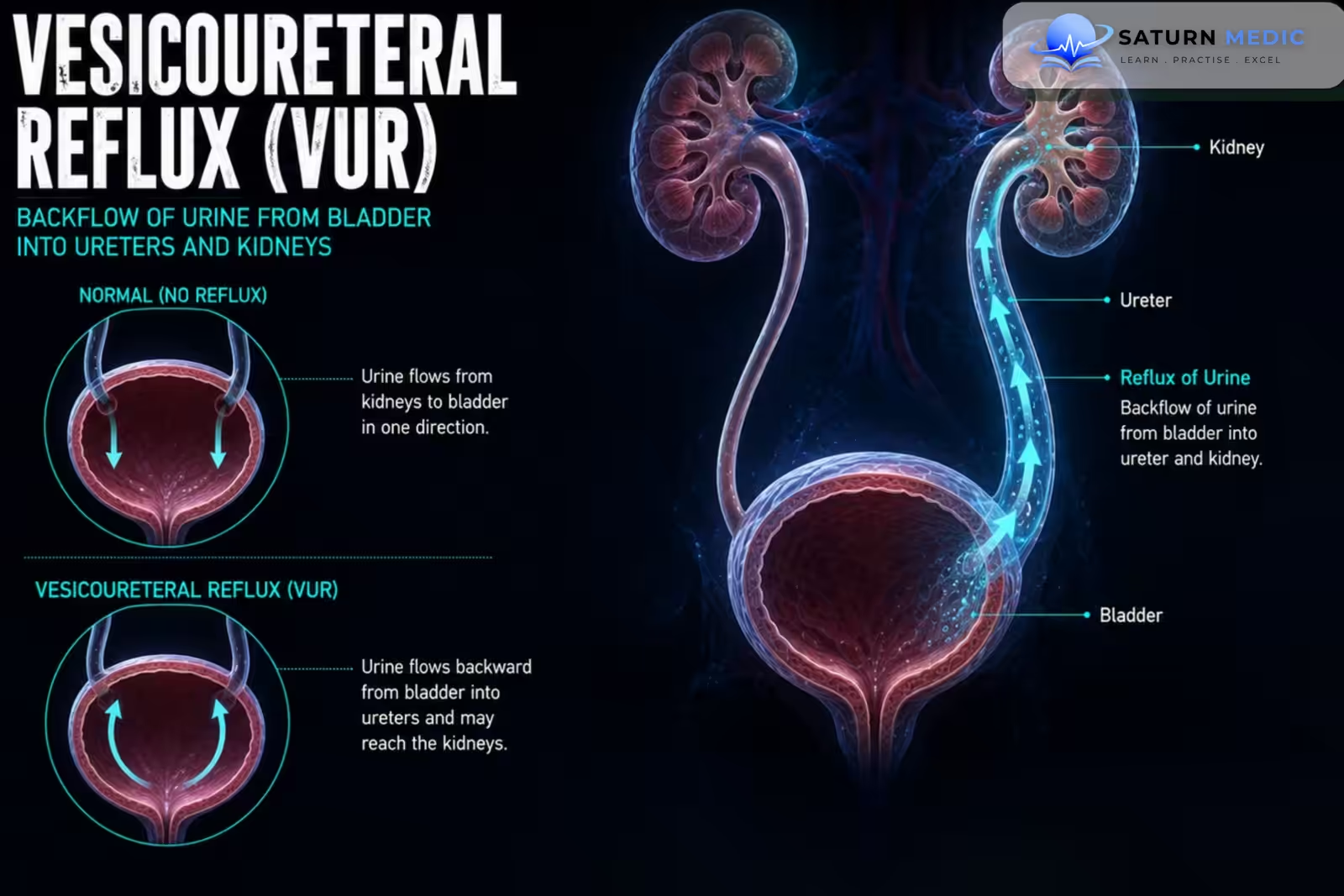
Vesicoureteral Reflux (VUR) is the backward flow of urine from the bladder into one or both ureters and sometimes into the kidneys. It increases the risk of recurrent urinary tract infections and, in severe cases, renal scarring and progressive kidney damage
Also called
Urinary reflux
ICD-10
N13.70
Specialty
Urology
Onset
Chronic
Reviewed
August 2026
On This Page
-
OverviewOverview
-
Etiology & Risk FactorsEtiology & Risk Factors
-
PathophysiologyPathophysiology
-
Clinical PresentationClinical Presentation
-
History TakingHistory Taking
-
Physical ExaminationPhysical Examination
-
InvestigationsInvestigations
-
DiagnosisDiagnosis
-
ManagementManagement
-
ComplicationsComplications
-
PrognosisPrognosis
-
Key Points / Clinical PearlsKey Points / Clinical Pearls
Overview
–Normally, the ureter enters the bladder through an oblique intramural tunnel that acts as a one-way valve during bladder filling and voiding.
In Vesicoureteral Reflux (VUR), this anti-reflux mechanism is abnormal, allowing urine to flow backward.
-VUR may be:
- Primary: caused by congenital abnormality of the ureterovesical junction.
- Secondary: caused by increased bladder pressure due to conditions such as bladder outlet obstruction or neurogenic bladder.
-VUR is commonly graded from I to V, with higher grades indicating increasing ureteral dilatation and renal involvement
Etiology & Risk Factors
-Etiology
–Primary Vesicoureteral Reflux (VUR)
Usually caused by a congenital defect in the ureterovesical junction, resulting in an inadequate intramural ureteral tunnel and failure of the normal anti-reflux mechanism.
-Secondary Vesicoureteral Reflux (VUR)
Caused by increased bladder pressure or abnormal bladder function, such as:
- Posterior urethral valves
- Neurogenic bladder
- Bladder outlet obstruction
- Dysfunctional voiding
-Risk Factors
- Family history of Vesicoureteral Reflux (VUR)
- Young age
- Female sex
- Recurrent febrile urinary tract infections
- Congenital urinary tract abnormalities
- Bladder and bowel dysfunction
Pathophysiology
Abnormal ureterovesical junction or increased bladder pressure → failure of the anti-reflux mechanism → retrograde flow of urine into the ureter ± kidney → recurrent urinary tract infection → renal inflammation → renal scarring → reflux nephropathy ± hypertension and Chronic Kidney Disease CKD
Clinical Presentation
–Symptoms
Many children are asymptomatic until they develop a urinary tract infection.
Possible features include:
- Fever
- Dysuria
- Urinary frequency
- Urgency
- Abdominal or flank pain
- Vomiting
- Poor feeding in infants
- Irritability
-Signs:
Signs may be absent between infections.
Possible findings include:
- Fever
- Failure to thrive in severe recurrent disease
- Hypertension in patients with renal scarring
- Features of Chronic Kidney Disease CKD in advanced reflux nephropathy
History Taking
-Ask about:
- Previous urinary tract infections
- Febrile urinary tract infections
- Age at first infection
- Frequency of recurrent infections
- Flank or abdominal pain
- Dysuria and urinary frequency
- Urinary urgency or incontinence
- Constipation
- Voiding habits
- Poor urinary stream
- Antenatal urinary tract abnormalities
Physical Examination
-General Examination
- Temperature
- Growth and weight
- Blood pressure
-System-Specific Examination:
- Abdominal examination for palpable bladder or kidneys
- Assessment for suprapubic tenderness
- Examination for spinal or neurological abnormalities when neurogenic bladder is suspected
Investigations
-Biochemistry / Specific Tests
Urinalysis for pyuria, bacteriuria, and hematuria
Urine culture to confirm urinary tract infection
Serum creatinine and estimated kidney function when renal impairment is suspected
Urine protein assessment when reflux nephropathy is present
-Imaging
Renal and Bladder Ultrasound
Used to assess:
Kidney size
Hydronephrosis
Ureteral dilatation
Structural abnormalities
- Bladder abnormalities
-Voiding Cystourethrogram (VCUG)
The key investigation for diagnosing and grading Vesicoureteral Reflux (VUR).
It demonstrates retrograde flow of contrast from the bladder into the ureters and kidneys.
-Dimercaptosuccinic Acid (DMSA) Scan
Used to assess:
Renal cortical defects
Renal scarring
Differential renal function
Diagnosis
-Diagnosis is based on:
Clinical suspicion, usually after recurrent or febrile urinary tract infections + demonstration of retrograde urine flow on VCUG.
-The severity of Vesicoureteral Reflux (VUR) is graded from I to V:
- Grade I: reflux into the ureter only
- Grade II: reflux into the ureter and renal pelvis without dilatation
- Grade III: mild-to-moderate dilatation
- Grade IV: moderate dilatation and tortuosity
- Grade V: severe dilatation and marked tortuosity with significant renal involvement
Management
1. First-Line / Emergency Management
There is no routine emergency treatment for uncomplicated Vesicoureteral Reflux (VUR).
A febrile urinary tract infection or pyelonephritis should be promptly treated with appropriate antimicrobial therapy.
2. Definitive Treatment
Management depends on:
Age
VUR grade
Frequency of febrile urinary tract infections
Presence of renal scarring
Bladder and bowel dysfunction
Kidney function
-Many cases of low-grade primary Vesicoureteral Reflux (VUR) resolve spontaneously as the child grows.
3. Medical Treatment
Prompt treatment of urinary tract infections
Continuous antibiotic prophylaxis in selected patients
Treatment of bladder and bowel dysfunction
Management of constipation
Blood pressure control when hypertension develops
Treatment of proteinuria and Chronic Kidney Disease CKD when present
4. Surgical / Procedural Treatment
Intervention may be considered for:
Persistent high-grade VUR
Breakthrough febrile urinary tract infections
Progressive renal damage
Selected anatomical abnormalities
Options include:
Endoscopic injection therapy
Ureteral reimplantation
5. Supportive Management
Encourage appropriate fluid intake
Regular and complete bladder emptying
Timed voiding
Constipation management
Complications
- Recurrent urinary tract infections
- Acute pyelonephritis
- Renal scarring
- Reflux nephropathy
- Proteinuria
- Hypertension
- Reduced renal function
- Chronic Kidney Disease CKD
- End Stage Renal Disease ESRD in severe cases
Prognosis
The prognosis depends mainly on the grade of reflux, age at diagnosis, frequency of febrile urinary tract infections, presence of bladder and bowel dysfunction, and the degree of renal scarring. Many children with low-grade primary Vesicoureteral Reflux (VUR) improve or resolve spontaneously. High-grade bilateral disease and established renal scarring carry a greater risk of long-term hypertension and Chronic Kidney Disease CKD.
Key Points / Clinical Pearls
- Vesicoureteral Reflux (VUR) is backward flow of urine from the bladder into the ureters and kidneys.
- It may be primary or secondary.
- Primary VUR usually results from an abnormal ureterovesical junction.
- Secondary VUR results from increased bladder pressure or abnormal bladder function.
- Recurrent febrile urinary tract infections are an important presentation.
- The major long-term concern is renal scarring.
- Voiding cystourethrogram (VCUG) confirms and grades Vesicoureteral Reflux (VUR).
- VUR is graded from I to V.
- Higher-grade VUR carries a greater risk of renal damage.
- A normal renal ultrasound does not exclude Vesicoureteral Reflux (VUR).
- Low-grade primary VUR often resolves spontaneously.
- Antibiotic prophylaxis is used only in selected patients.
- Bladder and bowel dysfunction should be actively treated.
- European Association of Urology (EAU). EAU Guidelines on Paediatric Urology .
- American Urological Association (AUA). Management and Screening of Primary Vesicoureteral Reflux in Children .
- Peters CA, Skoog SJ, Arant BS Jr, et al. Summary of the AUA Guideline on Management of Primary Vesicoureteral Reflux in Children. J Urol. 2010;184(3):1134-1144. Journal of Urology .
- Mattoo TK. Vesicoureteral Reflux and Reflux Nephropathy. Adv Chronic Kidney Dis. 2011;18(5):348-354. Advances in Chronic Kidney Disease .
- Copp HL, Schmidt B. Workup of Pediatric Urinary Tract Infection. Urol Clin North Am. 2015;42(4):519-526.
- National Institute of Diabetes and Digestive and Kidney Diseases (NIDDK). Vesicoureteral Reflux (VUR) . National Institutes of Health.
- National Library of Medicine (NIH). Vesicoureteral Reflux . StatPearls.