

Clinical Subject Page
Anal Fissure
An anal fissure is a small linear tear in the lining of the anal canal, usually caused by
trauma from passing hard stool. It typically causes severe sharp pain during or after
defecation with a small amount of bright red rectal bleeding
Also called
ICD-10
Specialty
Onset
Reviewed
-
OverviewOverview
-
Etiology & Risk FactorsEtiology & Risk Factors
-
PathophysiologyPathophysiology
-
Clinical PresentationClinical Presentation
-
History TakingHistory Taking
-
Physical ExaminationPhysical Examination
-
InvestigationsInvestigations
-
DiagnosisDiagnosis
-
ManagementManagement
-
ComplicationsComplications
-
PrognosisPrognosis
-
Key Points / Clinical PearlsKey Points / Clinical Pearls
Overview
Anal fissures are classified as:
– Acute fissure: Usually present for less than six weeks and appears as a fresh superficial tear.
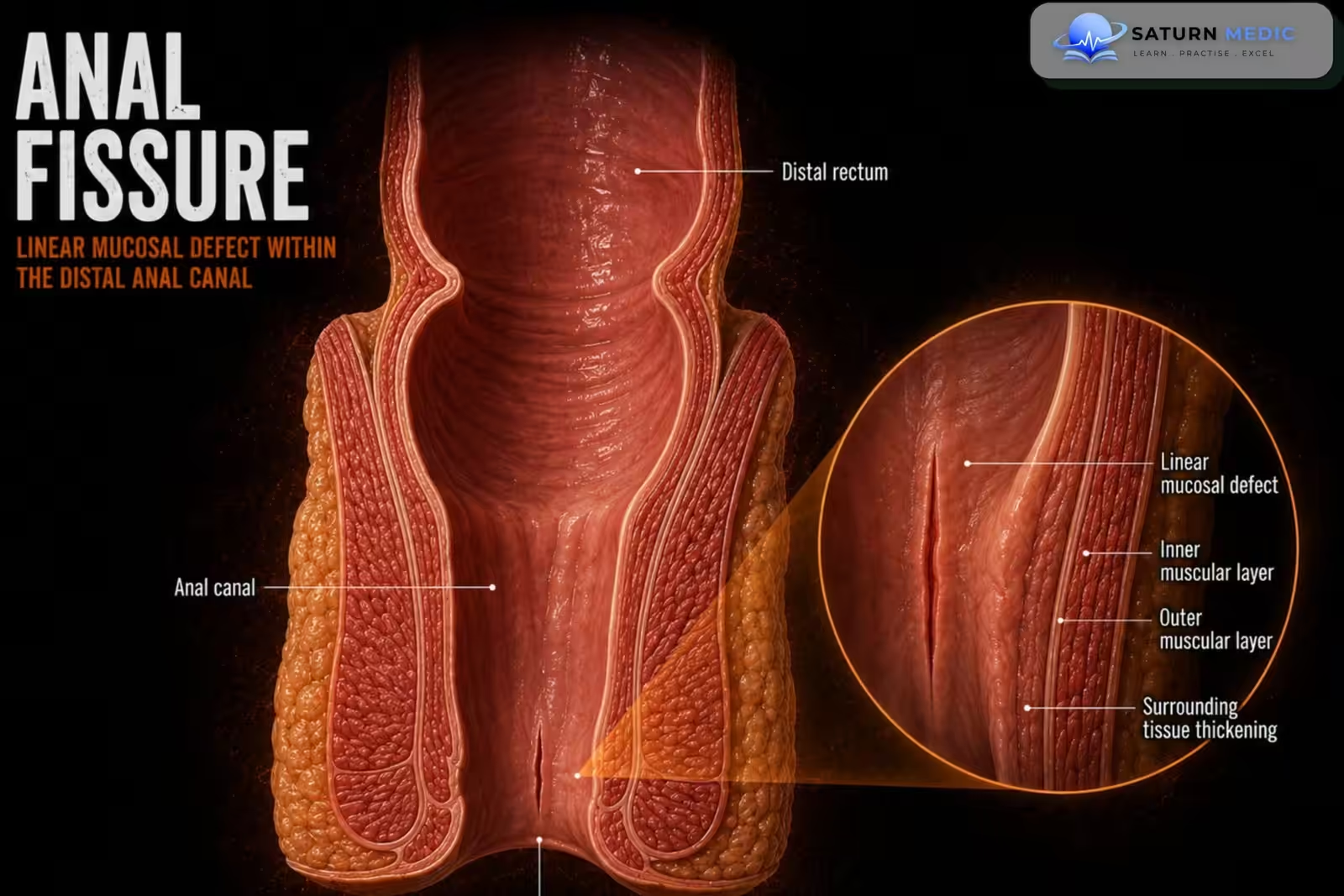
– Chronic fissure: Persists for approximately six weeks or longer and may have exposed internal sphincter fibers, a sentinel skin tag, or a hypertrophied anal papilla
Etiology & Risk Factors
Common Causes
– Passage of hard or large stool
– Chronic constipation
– Excessive straining
– Recurrent diarrhea
– Trauma during childbirth
– Local anal trauma
– Previous anorectal surgery
Risk Factors
– Low-fiber diet
– Inadequate fluid intake
– Chronic constipation
– Pregnancy and childbirth
– Inflammatory bowel disease, particularly Crohn disease
– Sexually transmitted infections
– Tuberculosis
– HIV infection
– Anal malignancy
– Leukemia or other immunosuppressive conditions
Pathophysiology
Passage of hard stool, repeated diarrhea, or local trauma causes a linear tear in the anoderm, usually in the posterior midline → pain triggers spasm of the internal anal sphincter → sphincter spasm reduces local blood flow, particularly to the posterior commissure → ischemia delays healing and causes persistent pain during and after defecation → repeated trauma reopens the fissure → chronic fissure develops with exposed internal sphincter fibers, a sentinel skin tag, and a hypertrophied anal papilla.
Clinical Presentation
Common Symptoms
– Severe sharp or tearing pain during defecation
– Burning pain lasting minutes to hours after defecation
– Small amount of bright red blood on toilet paper or stool
– Fear of defecation
– Constipation caused by avoidance of bowel movements
– Anal itching or irritation
Features of Chronic Anal Fissure
– Persistent or recurrent anal pain
– Sentinel skin tag
– Hypertrophied anal papilla
– Visible internal sphincter fibers
– Recurrent bleeding
History Taking
Ask about: When pain began, relation to defecation, pain after defecation, bright red
bleeding, constipation, hard stools, diarrhea, abdominal pain or weight loss, mucus/pus
discharge, Crohn disease, childbirth or anorectal surgery, infection/immunosuppression
symptoms, previous treatment
Physical Examination
General Examination
Assess for pallor, weight loss, fever, signs of inflammatory bowel disease, and
immunosuppression.
Perianal Inspection
Inspect for linear tear, posterior or anterior midline location, active bleeding, sentinel
skin tag, exposed internal sphincter fibers, hypertrophied anal papilla, multiple or
lateral fissures, abscess, fistula, ulcer, or mass.
Digital Rectal Examination
Often very painful and may not be necessary when a typical fissure is visible. Perform
cautiously if diagnosis is uncertain, rectal mass suspected, or another anorectal
condition must be excluded.
Anoscopy
May be postponed during severe pain; consider if fissure is not visible, bleeding needs
evaluation, or another disorder is suspected
Investigations
Clinical Diagnosis
Most typical fissures are diagnosed by characteristic history, gentle inspection, and identification of a midline tear.
Routine labs or imaging are usually unnecessary in
typical acute fissures without alarm features.
Laboratory Tests
CBC, CRP/ESR, infection testing when indicated (HIV, syphilis, STI testing, tuberculosis investigations, swab/culture/biopsy).
Endoscopic Evaluation
Anoscopy/proctoscopy to confirm diagnosis or identify other pathology.
Flexible sigmoidoscopy or colonoscopy when alarm features or suspected inflammatory bowel
disease are present.
Examination Under Anesthesia
Consider if examination is impossible, diagnosis uncertain, abscess/fistula/malignancy
suspected, or surgery planned.
Biopsy
Not routine; consider for atypical, persistent, multiple, indurated, infected, or
malignant-appearing fissures.
Important Investigation Note
A typical posterior midline fissure is usually a clinical diagnosis. Atypical, lateral,
multiple, or nonhealing fissures require further investigation for secondary causes
Diagnosis
Based on severe pain during and after defecation, small-volume bright red bleeding,
visible linear tear, and typical posterior or anterior midline location.
Acute: Fresh superficial tear, usually <6 weeks, no chronic skin changes.
Chronic: Approximately ≥6 weeks with sentinel tag, hypertrophied papilla, exposed
sphincter fibers, or fibrotic edges.
Related Topics
Management
1. Conservative Treatment – First-Line
Increase dietary fiber, fiber supplements if needed, adequate fluids, stool softeners or
osmotic laxatives if constipated, avoid straining and prolonged sitting, warm sitz baths,
simple analgesia, treat diarrhea.
2. Pain Relief
Topical lidocaine, paracetamol, avoid opioids.
3. Topical Sphincter-Relaxing Treatment
Topical diltiazem or nifedipine; topical nitroglycerin (headache common; avoid with
PDE-5 inhibitors).
4. Botulinum Toxin Injection
For failed/intolerant topical therapy or when surgery is undesirable.
5. Surgical Management
Lateral internal sphincterotomy for selected chronic/refractory fissures;
sphincter-preserving procedures in higher incontinence risk patients.
Important Management Note
Fiber, fluids, stool regulation, and sitz baths are first-line. Persistent chronic fissures are
treated with topical diltiazem, nifedipine, or nitroglycerin. Botulinum toxin or surgery is
considered when medical treatment fails
Complications
– Chronic anal fissure
– Recurrent fissure
– Sentinel skin tag
– Persistent pain
– Constipation due to fear of defecation
– Local infection or abscess, rarely
– Temporary or persistent incontinence after treatment
– Reduced quality of life
Prognosis
– Most acute anal fissures heal with conservative treatment.
– Chronic fissures may require topical sphincter-relaxing medication.
– Botulinum toxin may provide healing without permanent sphincter division.
– Lateral internal sphincterotomy has a high healing rate but carries a risk of impaired
continence.
– Maintaining soft stools reduces recurrence.
Key Points / Clinical Pearls
– An anal fissure is a linear tear in the lining of the anal canal.
– Typical symptom: severe pain during and after defecation.
– Bright red blood may appear on stool or toilet paper.
– Most primary fissures occur in the posterior midline.
– Diagnosis is usually by gentle visual inspection.
– Digital rectal examination may be deferred when pain is severe.
– Lateral or multiple fissures require investigation for secondary causes.
– Fiber, fluids, stool softening, and sitz baths are first-line.
– Topical diltiazem, nifedipine, or nitroglycerin for persistent chronic fissures.
– Botulinum toxin when topical treatment fails.
– Lateral internal sphincterotomy is the most effective surgical treatment for selected
refractory chronic fissures.
- Lieske B, Antunes C. National Center for Biotechnology Information (NIH). Sigmoid Volvulus, StatPearls.
- Le CK, Anand S, Cooper W. National Center for Biotechnology Information (NIH). Volvulus, StatPearls.
- Salati U, McNeill G, Torreggiani WC. The Coffee Bean Sign in Sigmoid Volvulus. Radiology. 2011;258:651-652. PMID: 21273530.
- Fu CG. Appropriate Treatment of Acute Sigmoid Volvulus in the Emergency Setting. World J Gastroenterol. 2013;19:4979-4983.
- MedlinePlus, National Library of Medicine (NIH). Intestinal Obstruction: Medical Encyclopedia.