

Clinical Subject Page
Annular Pancreas
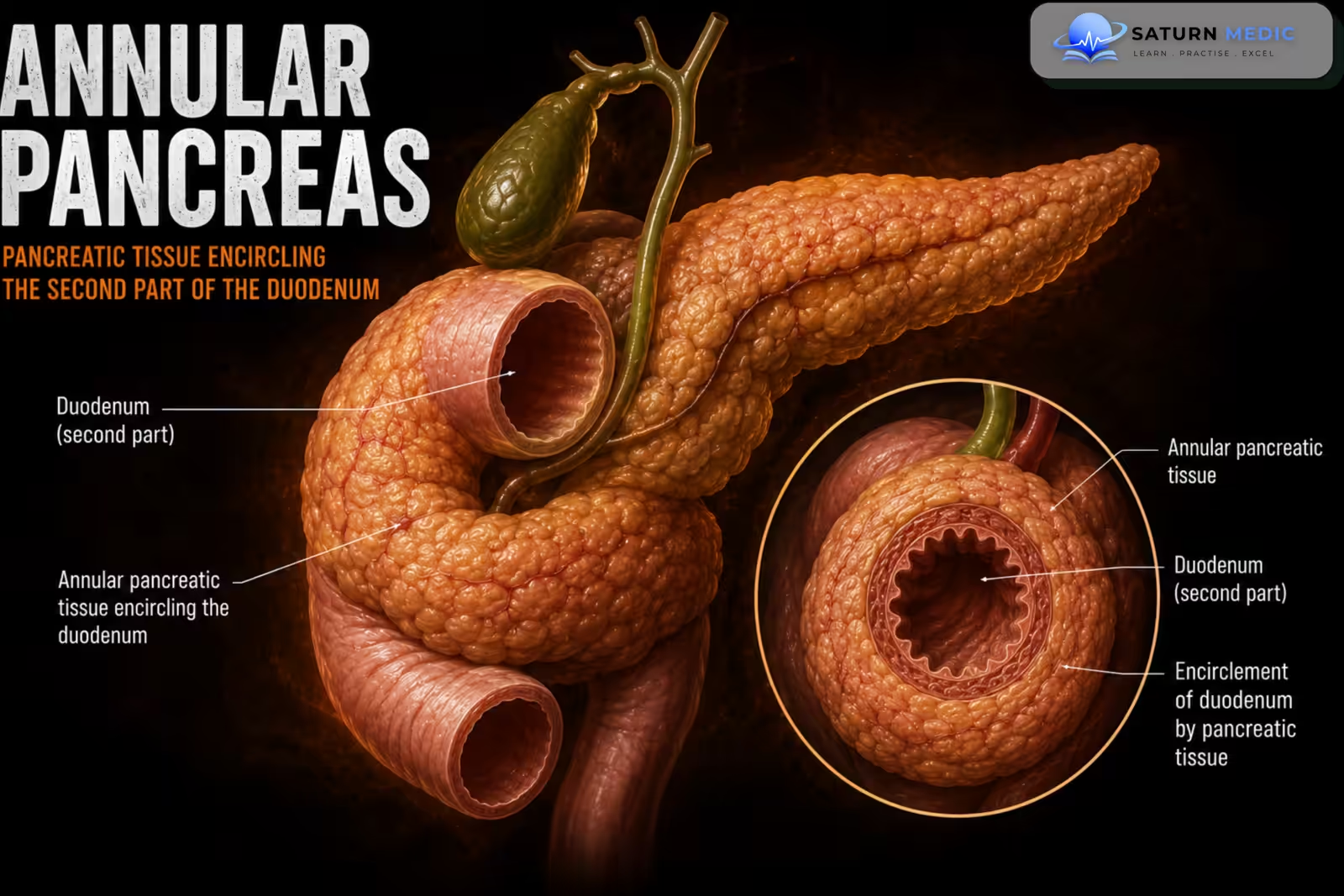
Annular pancreas is a rare congenital anomaly in which a complete or partial ring of pancreatic tissue surrounds the second part of the duodenum. It develops because of abnormal migration and malrotation of the ventral pancreatic bud during embryonic development.
ICD-10
Specialty
Onset
Reviewed
-
OverviewOverview
-
Etiology & Risk FactorsEtiology & Risk Factors
-
PathophysiologyPathophysiology
-
Clinical PresentationClinical Presentation
-
History TakingHistory Taking
-
Physical ExaminationPhysical Examination
-
InvestigationsInvestigations
-
DiagnosisDiagnosis
-
ManagementManagement
-
ComplicationsComplications
-
PrognosisPrognosis
-
Key Points / Clinical PearlsKey Points / Clinical Pearls
Overview
- May be complete or incomplete depending on how much of the duodenum is encircled.
- Many individuals are asymptomatic, while others present in infancy or adulthood.
- Symptoms are mainly due to duodenal obstruction and may include feeding difficulties and vomiting in neonates, or abdominal pain, nausea, vomiting, postprandial fullness, and pancreatitis in adults.
- Asymptomatic patients usually require no treatment, whereas symptomatic cases are typically managed with surgical bypass procedures (e.g., duodenoduodenostomy).
Etiology & Risk Factors
Etiology
- Congenital condition caused by defective migration and malrotation of the ventral pancreatic bud during embryonic development.
- This abnormal development forms a complete or partial ring of pancreatic tissue around the second part of the duodenum.
Risk Factors / Associated Conditions
- Annular pancreas is commonly associated with:
- Down syndrome
- Congenital heart defects
- Intestinal malrotation
- Duodenal atresia
- Meckel diverticulum
- There are no known acquired risk factors because annular pancreas is a congenital embryologic anomaly.
Pathophysiology
Defective migration and malrotation of the ventral pancreatic bud (embryonic development) → Ring of pancreatic tissue forms around the second part of the duodenum → Compression/narrowing of the duodenum → Partial or complete duodenal obstruction → Impaired passage of gastric contents → Vomiting, feeding difficulty, abdominal distention (or abdominal pain/postprandial fullness in adults) → May also lead to pancreatitis and biliary obstruction
Clinical Presentation
Many patients are asymptomatic. Symptoms depend on the age at presentation.
Prenatal
- Polyhydramnios
Neonates
- Feeding difficulties
- Abdominal distention
- Nonbilious or bilious vomiting
Adults
- Abdominal pain
- Nausea and/or vomiting
- Postprandial fullness
- Symptoms of pancreatitis
- Peptic ulcer disease
- Jaundice (uncommon)
History Taking
Ask about:
- When did the symptoms start?
- Is there vomiting? Is it bilious or nonbilious?
- Does vomiting occur after feeding or meals?
- Is there feeding difficulty or poor weight gain? (infants)
- Is there abdominal pain? Is it related to meals?
- Do you feel full quickly after eating (postprandial fullness)?
- Have you had recurrent episodes of pancreatitis?
- Have you noticed yellowing of the eyes/skin (jaundice)?
- Is there a history of Down syndrome or other congenital anomalies?
Physical Examination
- General appearance: May appear well if asymptomatic.
- Signs of dehydration: Dry mucous membranes, sunken eyes, tachycardia (from persistent vomiting).
- Abdominal distention: Especially in neonates with duodenal obstruction.
- Epigastric tenderness: If associated with acute pancreatitis.
- Visible vomiting (bilious or nonbilious), especially after feeds in infants.
- Poor weight gain/failure to thrive: In infants with chronic obstruction.
- Jaundice: May be present if there is biliary obstruction (uncommon).
- Signs of malnutrition: In prolonged or severe cases.
Investigations
Laboratory tests
- Usually not diagnostic
- Serum amylase/lipase if pancreatitis is suspected
- Liver function tests (bilirubin, ALP) if jaundice or biliary obstruction is suspected
Imaging (mainstay of diagnosis)
- Prenatal ultrasound: Polyhydramnios and features of duodenal obstruction
- Abdominal X-ray: Double bubble sign (duodenal obstruction)
- CT scan or MRI (best diagnostic imaging):
- Pancreatic tissue completely or partially encircling the second part of the duodenum
- Duodenal narrowing/thickening
- Proximal duodenal dilatation
diagnostic finding
- Ring (complete or partial) of pancreatic tissue surrounding the second part of the duodenum on cross-sectional imaging.
Diagnosis
-Diagnosis is based on :
- Diagnosis is based on clinical suspicion plus imaging findings.
Diagnostic criteria
- Symptoms of duodenal obstruction (or incidental finding in asymptomatic patients)
Cross-sectional imaging (CT or MRI) showing:
- Complete or partial ring of pancreatic tissue surrounding the second part of the duodenum (diagnostic finding)
- Duodenal narrowing/thickening
- Proximal duodenal dilatation
- Prenatal ultrasound or abdominal X-ray may support the diagnosis by showing a double bubble sign (duodenal obstruction).
Related Topics
Management
1. Initial/Supportive Management
- Keep NPO (nil by mouth) if there is significant obstruction.
- IV fluids to correct dehydration and electrolyte imbalance.
- Nasogastric (NG) tube for gastric decompression if persistent vomiting or obstruction.
- Treat associated complications (e.g., acute pancreatitis or biliary obstruction) as indicated.
2. Definitive Management
- Asymptomatic patients: No treatment required; observation and follow-up.
- Symptomatic patients: Surgical intervention is recommended.
3. Surgery (Treatment of Choice)
- Duodenoduodenostomy (preferred bypass procedure)
- Other bypass procedures may be used if needed.
- Do not resect the annular pancreatic tissue, as this increases the risk of pancreatic injury and complications.
Complications
- Duodenal obstruction (most common)
- Acute pancreatitis
- Chronic pancreatitis
- Biliary obstruction (may cause jaundice)
- Peptic ulcer disease
- The main complications result from compression of the duodenum and nearby biliary/pancreatic ducts.
Prognosis
- Excellent prognosis in asymptomatic patients; no treatment is usually needed.
- Good prognosis after surgical bypass (e.g., duodenoduodenostomy), with relief of duodenal obstruction in most patients.
- Prognosis depends on the severity of obstruction and the presence of complications (e.g., pancreatitis or biliary obstruction).
- Early diagnosis and treatment generally lead to favorable outcomes.
Key Points / Clinical Pearls
- Rare congenital anomaly with pancreatic tissue surrounding the second part of the duodenum.
- Caused by abnormal migration of the ventral pancreatic bud.
- Presents with duodenal obstruction or may be asymptomatic.
- CT or MRI confirms the diagnosis.
- Asymptomatic: Observation only.
- Symptomatic: Duodenoduodenostomy (bypass surgery) is the treatment of choice.
- Main complications: Duodenal obstruction, pancreatitis, and biliary obstruction.
- Aleem A, Desai H, Shah H. National Center for Biotechnology Information (NIH). Annular Pancreas, StatPearls.
- Vlad C, Todor C, Iancu G, et al. Clinical Analysis of Congenital Duodenal Obstruction and the Role of Annular Pancreas. Diagnostics (Basel). PMC11857210.
- Annular Pancreas Presenting with Intermittent Duodenal Obstruction in Early Childhood: A Diagnostic Masquerade. Reports. PMC12821695.
- MedlinePlus, National Library of Medicine (NIH). Annular Pancreas: Medical Encyclopedia.
- National Center for Biotechnology Information (NIH). Duodenal Atresia and Stenosis, StatPearls.