

Clinical Subject Page
Malaria
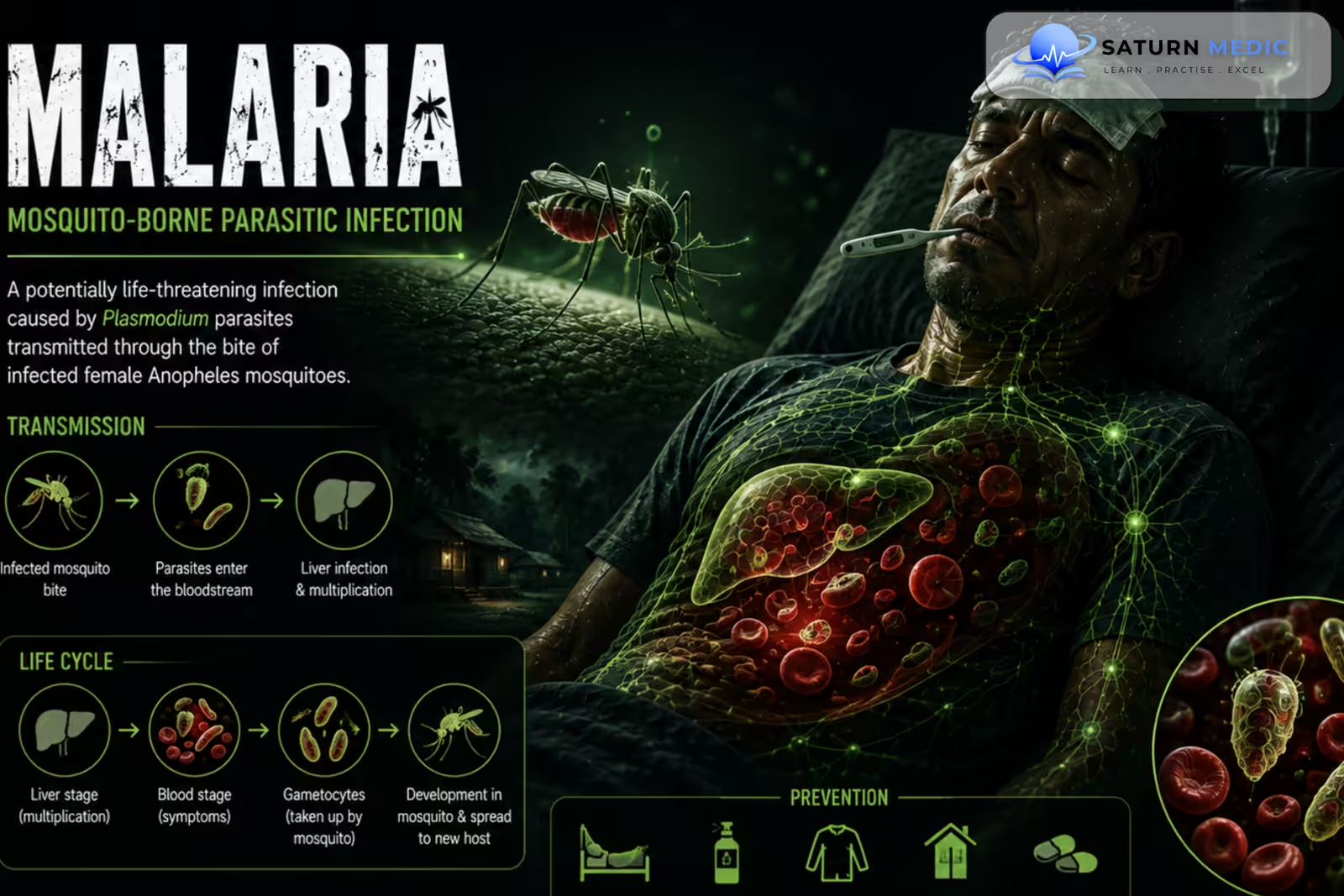
Malaria is an acute febrile infection caused by Plasmodium parasites and transmitted mainly through the bite of infected female Anopheles mosquitoes. The most important human species are Plasmodium falciparum, P. vivax, P. ovale, P. malariae, and P. knowlesi
Also called
ICD-10
Specialty
Onset
Reviewed
-
OverviewOverview
-
Etiology & Risk FactorsEtiology & Risk Factors
-
PathophysiologyPathophysiology
-
Clinical PresentationClinical Presentation
-
Causative AgentsCausative Agents
-
History TakingHistory Taking
-
Physical ExaminationPhysical Examination
-
InvestigationsInvestigations
-
DiagnosisDiagnosis
-
ManagementManagement
-
ComplicationsComplications
-
PrognosisPrognosis
-
Key Points / Clinical PearlsKey Points / Clinical Pearls
Overview
–Malaria begins when infected mosquitoes inject Plasmodium sporozoites into the bloodstream. The parasites first multiply in the liver and then infect red blood cells.
Important species include:
- P. falciparum: most likely to cause severe and fatal disease
- P. vivax: can relapse because of dormant liver hypnozoites
- P. ovale: can also cause relapse
- P. malariae: may produce chronic low-grade infection
- P. knowlesi: can cause rapidly progressive severe disease
Etiology & Risk Factors
-Etiology
–Malaria is caused by intracellular protozoa of the genus Plasmodium. Transmission occurs mainly through infected female Anopheles mosquitoes.
Rare transmission can occur through:
- Blood transfusion
- Shared needles
- Congenital transmission
-Risk Factors
- Residence or travel in an endemic area
- Lack of effective malaria prevention
- Lack of immunity
- Young age
- Pregnancy
- Immunosuppression
Pathophysiology
Mosquito bite → sporozoites enter blood → hepatic replication → merozoites released → red blood cell invasion → erythrocyte rupture → inflammatory response and fever → repeated cycles of parasitemia → anemia and systemic complications
In P. falciparum infection, infected erythrocytes can adhere to vascular endothelium, causing microvascular obstruction and severe organ dysfunction.
Clinical Presentation
-Symptoms:
Malaria commonly causes:
- Fever
- Chills or rigors
- Headache
- Sweating
- Myalgia
- Fatigue
- Nausea
- Vomiting
- Abdominal discomfort
The fever may be intermittent, but a regular periodic pattern is not always present.
-Signs:
Fever
Pallor
Tachycardia
Splenomegaly
Hepatomegaly in some patients
- Jaundice in severe disease
-Severe Disease may cause:
Altered consciousness
Seizures
Severe anemia
Hypoglycemia
Acute Kidney Injury (AKI)
Metabolic acidosis
Respiratory distress
Hemoglobinuria
Shock
Multiorgan failure
Malaria · Causative Agents — Plasmodium Species
| Feature | P. falciparum | P. vivax | P. ovale | P. malariae | P. knowlesi |
|---|---|---|---|---|---|
| Fever cycle | Irregular / continuous — no classic periodicity early | 48h — Tertian fever every 3rd day | 48h — Tertian fever every 3rd day | 72h — Quartan fever every 4th day | 24h — Quotidian daily fever |
| RBC preference | All ages — any RBC → highest parasitaemia | Young / reticulocytes — Duffy antigen required | Reticulocytes — similar to vivax | Old RBCs — low parasitaemia | All ages — similar to falciparum |
| RBC changes | No enlargement. Knobs on surface — cytoadherence → sequestration in capillaries | Enlarged. Schüffner's dots (stippling) | Enlarged + oval / fimbriated. Schüffner's dots | Not enlarged. Band form trophozoites — diagnostic | Not enlarged. Similar to malariae on film — misidentification common |
| Liver stage | No dormant stage — no hypnozoites | Hypnozoites — dormant in liver; cause relapses months–years later | Hypnozoites — same as vivax; relapses | No hypnozoites. Recrudescence — persistent low-level blood infection | No hypnozoites. No relapses. |
| Severity | Most severe — cerebral malaria, ARDS, AKI, severe anaemia, hypoglycaemia, DIC | Moderate — severe anaemia, splenic rupture possible. Rare cerebral vivax. | Mildest — self-limiting. Rarely severe. | Mild acutely. Nephrotic syndrome — quartan malaria nephropathy (chronic) | Underestimated — rapidly progressive; multi-organ failure possible |
| Geographic distribution | Sub-Saharan Africa (highest burden), South/SE Asia, Americas | Worldwide — widest distribution. South/SE Asia, Americas, Africa (limited) | West/Central Africa mainly. SE Asia rarely. | Sub-Saharan Africa, South/SE Asia, Pacific | SE Asia only — Borneo (Malaysia, Indonesia), Philippines. Zoonosis from macaques. |
| Key morphology | Multiple rings per RBC. Accole / appliqué forms. Banana-shaped gametocytes. | Large ameboid trophozoites. Schüffner's dots. Merozoites 12–24. | Oval/fimbriated RBCs. Schüffner's dots. 8 merozoites. | Band form trophozoites — pathognomonic. Rosette schizonts (8 merozoites). | Resembles malariae — only PCR/sequencing reliably distinguishes. |
| Treatment note | ACT — artemisinin-based. IV artesunate for severe. Check CQ resistance (almost universal). | CQ if sensitive + Primaquine — eliminates hypnozoites. Check G6PD first. | CQ + Primaquine — same as vivax for hypnozoites. Shorter course. | CQ — usually sensitive. No primaquine needed (no hypnozoites). | ACT or CQ (usually sensitive). Treat promptly — rapid deterioration. |
History Taking
-Ask about:
- Fever and duration
- Chills and rigors
- Recent travel or residence in a malaria-endemic region
- Previous malaria infection
- Use of mosquito protection
- Malaria chemoprophylaxis
- Pregnancy
- Antimalarial treatment already received
- Blood transfusion or injection exposure
Physical Examination
-General Examination
- Temperature
- Blood pressure
- Heart rate
- Respiratory rate
- Mental status
- Hydration
- Pallor
- Jaundice
-System-Specific Examination:
- Splenomegaly
- Hepatomegaly
- Neurological examination
- Respiratory assessment
- Assessment for signs of shock
Investigations
-Complete Blood Count
Important for detecting:
-
Anemia
-
Thrombocytopenia
-
Leukocyte abnormalities
-Peripheral Blood Film
Essential for diagnosis.
Thick and thin blood films can:
-
Detect parasites
-
Identify Plasmodium species
-
Estimate parasite density
-Biochemistry / Specific Tests
-
Blood glucose
-
Serum electrolytes
-
Urea and creatinine
-
Liver function tests
-
Lactate and blood gas analysis in severe disease
Rapid Diagnostic Tests
Malaria antigen rapid diagnostic tests can provide rapid evidence of infection but may not reliably determine parasite density or distinguish every species.
-Imaging
Not routinely required.
Imaging is directed toward complications or alternative diagnoses.
-Special / Confirmatory Tests
Repeat blood films may be necessary when initial testing is negative but clinical suspicion remains high.
Parasitemia should be quantified in confirmed infection, particularly when severe falciparum disease is suspected.
Diagnosis
-Diagnosis is Established by detecting Plasmodium parasites or parasite antigens in the blood.
Fever + compatible exposure → blood film and/or rapid diagnostic test → identify species and parasite density → assess for severe disease
Related Topics
Management
Malaria · Severe Malaria — Criteria & Management
| Drug / Intervention | Dose & Route | Role | Notes |
|---|---|---|---|
| IV Artesunate 1st line — gold standard |
2.4 mg/kg IV at 0, 12, 24h → then daily until able to take oral | Fastest parasite clearance of any antimalarial. Reduces mortality vs quinine by 35%. Crosses blood-brain barrier. Safe in pregnancy. | Switch to oral ACT × 3 days to complete course once conscious. Monitor for post-artesunate delayed haemolysis (PADH) — day 7–30. |
| IV Quinine Alternative if artesunate unavailable |
Loading dose: 20 mg/kg IV over 4h. Maintenance: 10 mg/kg q8h. Switch to oral when possible. | Effective but inferior to artesunate. Use with Doxycycline or Clindamycin (adds antibacterial + antimalarial synergy). | Monitor ECG — QT prolongation, arrhythmia. Hypoglycaemia — stimulates insulin. Cinchonism: tinnitus, hearing loss, dizziness. |
| IM Artemether If IV access unavailable |
3.2 mg/kg IM loading → 1.6 mg/kg IM daily | Alternative to IV artesunate when IV access not possible. Less reliable absorption than IV. | Preferably switch to IV artesunate / oral ACT as soon as possible. |
| Rectal Artesunate Pre-referral — community level |
10 mg/kg PR single dose | WHO-recommended pre-referral treatment for children <6 years with severe malaria when IV not available. Buys time for transfer. | Refer immediately after giving. Not a substitute for definitive IV treatment. |
Malaria · Treatment by Species
| Species | 1st Line | Alternative | Special considerations |
|---|---|---|---|
| P. falciparum Most dangerous |
ACT — Artemether-Lumefantrine (Coartem) — 6 doses over 3 days. Take with fatty food (↑ lumefantrine absorption). Or Artesunate-Amodiaquine / Artesunate-Mefloquine — region-dependent |
Atovaquone-Proguanil (Malarone) — 3 days. Good for travel. No G6PD issue. Quinine + Doxycycline × 7 days — if ACT unavailable |
Chloroquine resistance near-universal — never use alone for falciparum. Pregnant 1st trimester: Quinine + Clindamycin (avoid ACT). 2nd/3rd trimester: ACT safe. |
| P. vivax Relapse risk |
Chloroquine 25 mg/kg over 3 days (where sensitive) + Primaquine 15 mg OD × 14 days — eliminates hypnozoites OR Tafenoquine single dose — newer alternative |
CQ-resistant vivax (Papua New Guinea, Indonesia, parts of SE Asia): ACT + Primaquine | Check G6PD before primaquine/tafenoquine — haemolytic anaemia in G6PD deficiency. Tafenoquine: contraindicated if G6PD <70%. Pregnancy: CQ only — no primaquine. |
| P. ovale Mildest |
Chloroquine + Primaquine 15 mg OD × 14 days (Same as vivax — also has hypnozoites) |
ACT — if CQ resistant (rare for ovale) | Check G6PD before primaquine. Shorter course than vivax sometimes used (30 mg × 7 days in non-G6PD deficient). |
| P. malariae Quartan |
Chloroquine 25 mg/kg over 3 days — universally sensitive | ACT — if uncertain species | No primaquine needed — no hypnozoites. Monitor renal function — quartan nephropathy. Recrudescence possible (not relapse). |
| P. knowlesi Zoonotic |
Chloroquine — usually sensitive ACT — if severe or uncertain |
Artemether-Lumefantrine | Treat promptly — can deteriorate rapidly despite mild initial presentation. No hypnozoites. No primaquine. |
Complications
- Severe anemia
- Cerebral malaria
- Hypoglycemia
- Acute Kidney Injury (AKI)
- Metabolic acidosis
- Respiratory distress
- Hemoglobinuria
- Jaundice
- Shock
- Multiorgan failure
- Death
Prognosis
The prognosis depends on the species, parasite burden, age, pregnancy status, immune status, and speed of treatment. Uncomplicated disease usually responds well to appropriate therapy. Severe P. falciparum or P. knowlesi infection can progress rapidly and may be fatal without prompt treatment.
Key Points / Clinical Pearls
- Malaria is caused by Plasmodium parasites.
- It is transmitted mainly by infected female Anopheles mosquitoes.
- P. falciparum is the species most associated with severe disease.
- P. vivax and P. ovale can relapse from dormant liver stages.
- Fever, chills, headache, and malaise are common.
- A regular periodic fever pattern is not required.
- Recent travel or residence in an endemic area is a major diagnostic clue.
- Thick and thin blood films are central to diagnosis.
- Rapid diagnostic tests can provide rapid evidence of infection.
- Parasite density should be assessed in confirmed disease.
- Severe Disease can cause cerebral disease, severe anemia, hypoglycemia, and kidney injury.
- World Health Organization (WHO). Malaria .
- Centers for Disease Control and Prevention (CDC). Malaria .
- World Health Organization (WHO). Guidelines for Malaria .
- White NJ. Malaria. Lancet. 2014;383(9918):723-735. PubMed .
- Ashley EA, Pyae Phyo A, Woodrow CJ. Malaria. Lancet. 2018;391(10130):1608-1621. PubMed .
- Milner DA Jr. Malaria Pathogenesis. Cold Spring Harb Perspect Med. 2018;8(1):a025569. PubMed .
- National Library of Medicine (NIH). Malaria . StatPearls.