

Clinical Subject Page
Obstructive Sleep Apnea (OSA)
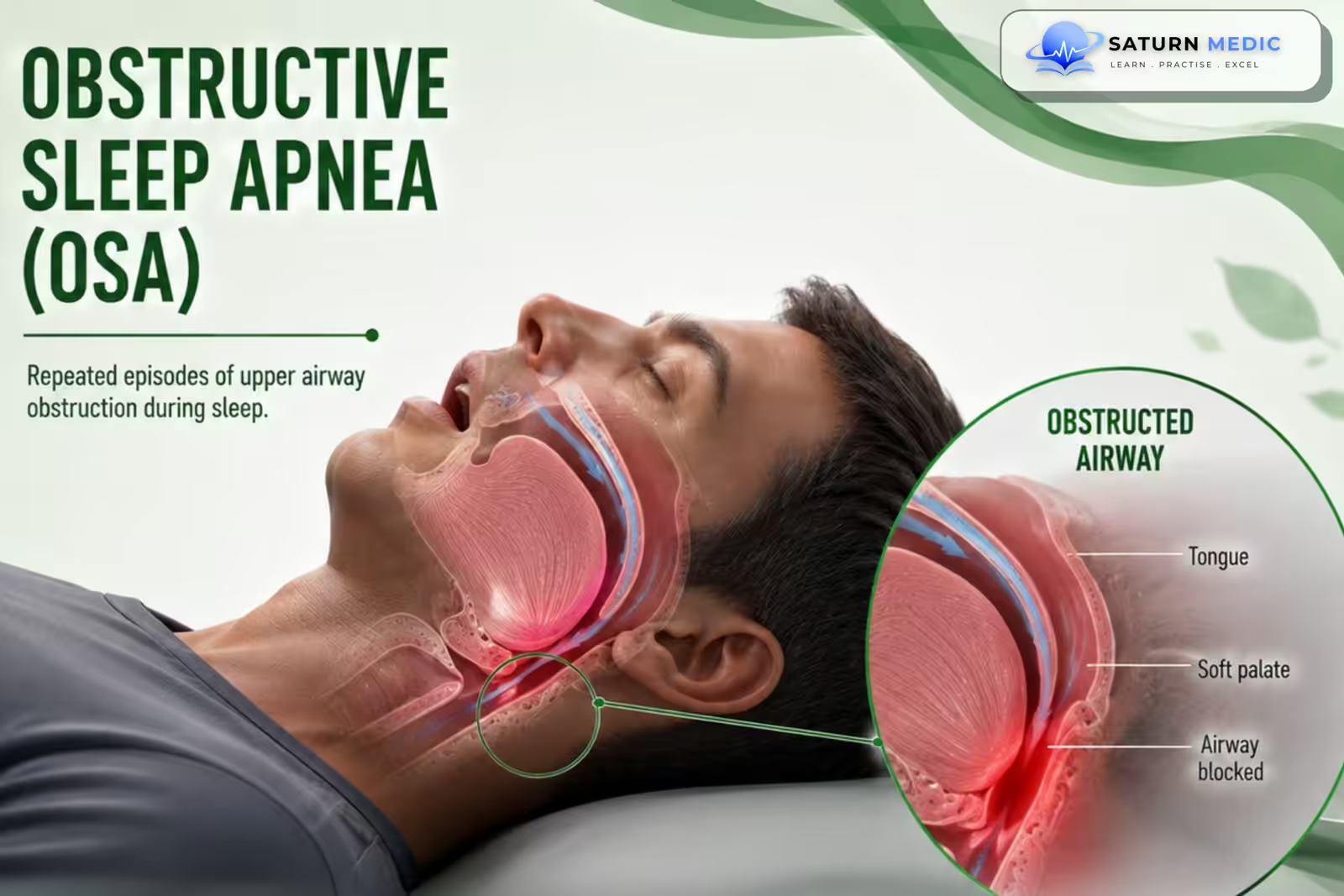
Obstructive sleep apnea (OSA) is a sleep-related breathing disorder characterized by repeated episodes of partial or complete upper airway obstruction during sleep, causing reduced or absent airflow despite continued breathing effort.
Also called
ICD-10
Specialty
Onset
Reviewed
-
OverviewOverview
-
Etiology & Risk FactorsEtiology & Risk Factors
-
PathophysiologyPathophysiology
-
Clinical PresentationClinical Presentation
-
History TakingHistory Taking
-
Physical ExaminationPhysical Examination
-
InvestigationsInvestigations
-
DiagnosisDiagnosis
-
ManagementManagement
-
ComplicationsComplications
-
PrognosisPrognosis
-
Key Points / Clinical PearlsKey Points / Clinical Pearls
Overview
During sleep, the upper airway repeatedly narrows or collapses, causing:
- Reduced airflow (hypopnea)
- Complete airflow cessation (apnea)
- Intermittent hypoxemia
- Repeated sleep disruption
This leads to poor-quality sleep, daytime sleepiness, and cardiovascular complications.
Etiology & Risk Factors
Main Mechanism
Obstructive Sleep Apnea (OSA) occurs when the upper airway becomes too narrow or collapses during sleep.
Major Risk Factors
-
Obesity
-
Increasing age
-
Male sex
-
Large neck circumference
-
Craniofacial abnormalities
-
Enlarged tonsils or adenoids
-
Family history of OSA
Other Risk Factors For Obstructive Sleep Apnea (OSA)
-
Alcohol use
-
Sedative medications
-
Nasal obstruction
-
Smoking
-
Menopause
-
Hypothyroidism
-
Acromegaly
Important Note
Obesity is the most important modifiable risk factor for OSA.
Pathophysiology
Anatomically narrow or collapsible upper airway
⬇
Reduced upper airway muscle tone during sleep
⬇
Partial or complete airway collapse
⬇
Hypopnea or apnea
⬇
Intermittent hypoxemia + Increased CO₂
⬇
Brief arousal from sleep
⬇
Airway reopens
⬇
Repeated cycles throughout the night
⬇
Sleep fragmentation + Sympathetic activation
⬇
Daytime symptoms + Cardiovascular complications
Clinical Presentation
-Nighttime Symptoms
-
Loud habitual snoring
-
Witnessed apneas
-
Choking or gasping during sleep
-
Restless sleep
-
Frequent awakenings
-
Nocturia
-Daytime Symptoms
-
Excessive daytime sleepiness
-
Morning headache
-
Fatigue
-
Poor concentration
-
Memory problems
-
Irritability
-
Reduced work or academic performance
-Signs
-
-
Obesity
-
Large neck circumference
-
Crowded upper airway
-
Enlarged tonsils
-
Hypertension
-
History Taking
Ask about:
- Loud snoring?
- Witnessed breathing pauses?
- Choking or gasping during sleep?
- Excessive daytime sleepiness?
- Morning headaches?
- Unrefreshing sleep?
- Poor concentration?
- Frequent nighttime urination?
- Falling asleep while driving?
- Weight gain?
- Alcohol use?
Physical Examination
-General Examination
Look for:
- Obesity
- Increased neck circumference
- Hypertension
-Upper Airway Examination
Look for:
- Crowded oropharynx
- Enlarged tonsils
- Large tongue
- Retrognathia
- Nasal obstruction
-Important Note
A normal physical examination does not exclude OSA.
Investigations
-Polysomnography — Standard Diagnostic Test
An overnight sleep study assesses:
-
Airflow
-
Respiratory effort
-
Oxygen saturation
-
Heart rate
-
Sleep stages
-
Apnea and hypopnea episodes
-Home Sleep Apnea Testing
May be used in selected adults with a high clinical suspicion of uncomplicated OSA.
-Apnea–Hypopnea Index (AHI)
The number of apneas and hypopneas per hour of sleep.
Severity
-
Mild: AHI 5–14 events/hour
-
Moderate: AHI 15–29 events/hour
-
Severe: AHI ≥30 events/hour
-Additional Tests
When indicated:
-
-
Thyroid function tests
-
Arterial blood gas
-
ECG
-
Echocardiography
-
Diagnosis
Obstructive Sleep Apnoea (OSA) · Diagnostic Criteria
| Severity | AHI (events/hour) | Typical Features | Treatment Threshold |
|---|---|---|---|
| Normal | <5 events/hour | No significant sleep-disordered breathing; snoring may still be present | No OSA-specific treatment; general sleep hygiene advice |
| Mild OSA | 5–14 events/hour | Mild symptoms; some sleepiness; ESS typically 10–12 | CPAP if symptomatic or comorbidities present; positional therapy/mandibular advancement device for positional mild OSA |
| Moderate OSA | 15–29 events/hour | More frequent arousals; significant daytime sleepiness; ESS typically 12–15 | CPAP recommended; weight loss; optimise sleep position |
| Severe OSA | ≥30 events/hour | Severe sleepiness, significant nocturnal hypoxia, increased cardiovascular and metabolic risk; ESS typically >15 | CPAP strongly indicated; urgent in drivers, occupational risk; consider BiPAP/ASV if CPAP-intolerant |
Related Topics
Management
Obstructive Sleep Apnoea (OSA) · Treatment
| Treatment | Indication | Notes |
|---|---|---|
| Lifestyle & Behavioural | All patients | Weight loss most impactful — 10% weight loss can reduce AHI by 26%. Avoid alcohol and sedatives (worsen muscle relaxation). Avoid supine sleeping. Smoking cessation reduces pharyngeal inflammation. |
| Positional Therapy | Positional OSA (AHI ≥2x worse supine) | Positional OSA device or tennis-ball technique to prevent supine sleep. Effective first-line for mild-moderate positional OSA. |
| CPAP (Continuous Positive Airway Pressure) | Moderate OSA (AHI ≥15) or Symptomatic mild OSA | Gold standard. Titrated to eliminate apnoeas (usually 5–15 cmH2O). Auto-CPAP (APAP) self-adjusts nightly. Adherence ≥4h/night on ≥70% of nights is benchmark. Reduces sleepiness, BP, cardiovascular risk. |
| BiPAP (Bilevel PAP) | CPAP intolerance or Coexisting hypoventilation | Separate inspiratory (IPAP) and expiratory (EPAP) pressures. Useful in obesity hypoventilation, COPD-OSA overlap, or CPAP pressure intolerance. |
| Mandibular Advancement Device (MAD) | Mild-moderate OSA or CPAP refusal/failure | Custom-fitted by a dentist. Less effective than CPAP but better tolerated. Contraindicated with severe temporomandibular joint disease or insufficient dentition. |
| Hypoglossal Nerve Stimulation (Inspire) | Moderate-severe OSA + CPAP failure | Implantable device stimulates hypoglossal nerve → protrudes tongue during inspiration. AHI 25–65, BMI ≤32, no concentric palatal collapse on DISE. Growing evidence base. |
| Upper Airway Surgery | Anatomical obstruction + CPAP failure | Tonsillectomy/adenoidectomy (especially children and adults with tonsillar hypertrophy). UPPP (uvulopalatopharyngoplasty) for selected adults. Variable outcomes — patient selection critical. |
| Bariatric Surgery | BMI ≥35 + OSA | Significant weight loss can achieve OSA remission in many patients. Not a guaranteed cure — post-operative sleep study recommended to confirm resolution before stopping CPAP. |
| Treat Comorbidities | All patients | Optimise HTN, AF, T2DM, hypothyroidism (worsens OSA). Nasal obstruction treatment (topical steroids, septoplasty) improves CPAP tolerance. |
Complications
- Systemic hypertension
- Pulmonary hypertension
- Coronary artery disease
- Heart failure
- Cardiac arrhythmias
- Stroke
- Insulin resistance
- Type 2 diabetes
- Cognitive impairment
- Depression
- Motor vehicle accidents
- Reduced quality of life
Prognosis
- OSA is a chronic but treatable condition.
- Prognosis improves with:
- Weight loss
- Effective CPAP use
- Good treatment adherence
- Management of cardiovascular risk factors
- Untreated severe OSA increases the risk of:
- Cardiovascular disease
- Stroke
- Accidents
- Reduced quality of life
- Long-term treatment can significantly improve symptoms and outcomes.
Key Points / Clinical Pearls
- OSA is caused by repeated upper airway collapse during sleep.
- Obesity is the most important modifiable risk factor.
- Loud snoring, witnessed apneas, and daytime sleepiness are classic features.
- Polysomnography is the standard diagnostic test.
- AHI is used to classify OSA severity.
- CPAP is the main treatment for many patients with OSA.
- Weight loss is an important part of management.
- Untreated OSA increases cardiovascular and accident risk.
- Falling asleep while driving is a major warning sign.
- A normal physical examination does not exclude OSA.
- Patil SP, Ayappa IA, Caples SM, Kimoff RJ, Patel SR, Harrod CG. Treatment of Adult Obstructive Sleep Apnea with Positive Airway Pressure: An American Academy of Sleep Medicine Clinical Practice Guideline. Journal of Clinical Sleep Medicine . 2019;15(2):335-343.
- Stansbury RC, Strollo PJ. Clinical manifestations of obstructive sleep apnea. StatPearls / NCBI Bookshelf .
- Senaratna CV, Perret JL, Lodge CJ, et al. Prevalence of obstructive sleep apnea in the general population: A systematic review. Sleep Medicine Reviews . 2017;34:70-81.
- Jordan AS, McSharry DG, Malhotra A. Adult obstructive sleep apnoea. The Lancet . 2014;383(9918):736-747.
- Epstein LJ, Kristo D, Strollo PJ Jr, et al. Clinical guideline for the evaluation, management and long-term care of obstructive sleep apnea in adults. Journal of Clinical Sleep Medicine . 2009;5(3):263-276.
- National Institute for Health and Care Excellence (NICE). Obstructive sleep apnoea/hypopnoea syndrome and obesity hypoventilation syndrome . NICE Guideline NG202.