
Also called
ICD-10
Specialty
Onset
Reviewed
-
OverviewOverview
-
Etiology & Risk FactorsEtiology & Risk Factors
-
PathophysiologyPathophysiology
-
Clinical PresentationClinical Presentation
-
History TakingHistory Taking
-
Physical ExaminationPhysical Examination
-
InvestigationsInvestigations
-
DiagnosisDiagnosis
-
ManagementManagement
-
ComplicationsComplications
-
PrognosisPrognosis
-
Key Points / Clinical PearlsKey Points / Clinical Pearls
What is Pneumocystis jirovecii pneumonia (PJP)?
-
Pneumocystis Pneumonia (PJP) is one of the most common opportunistic infections in patients with:
- HIV/AIDS
- Organ transplantation
- Hematologic malignancies
- Long-term immunosuppressive therapy
The infection causes:
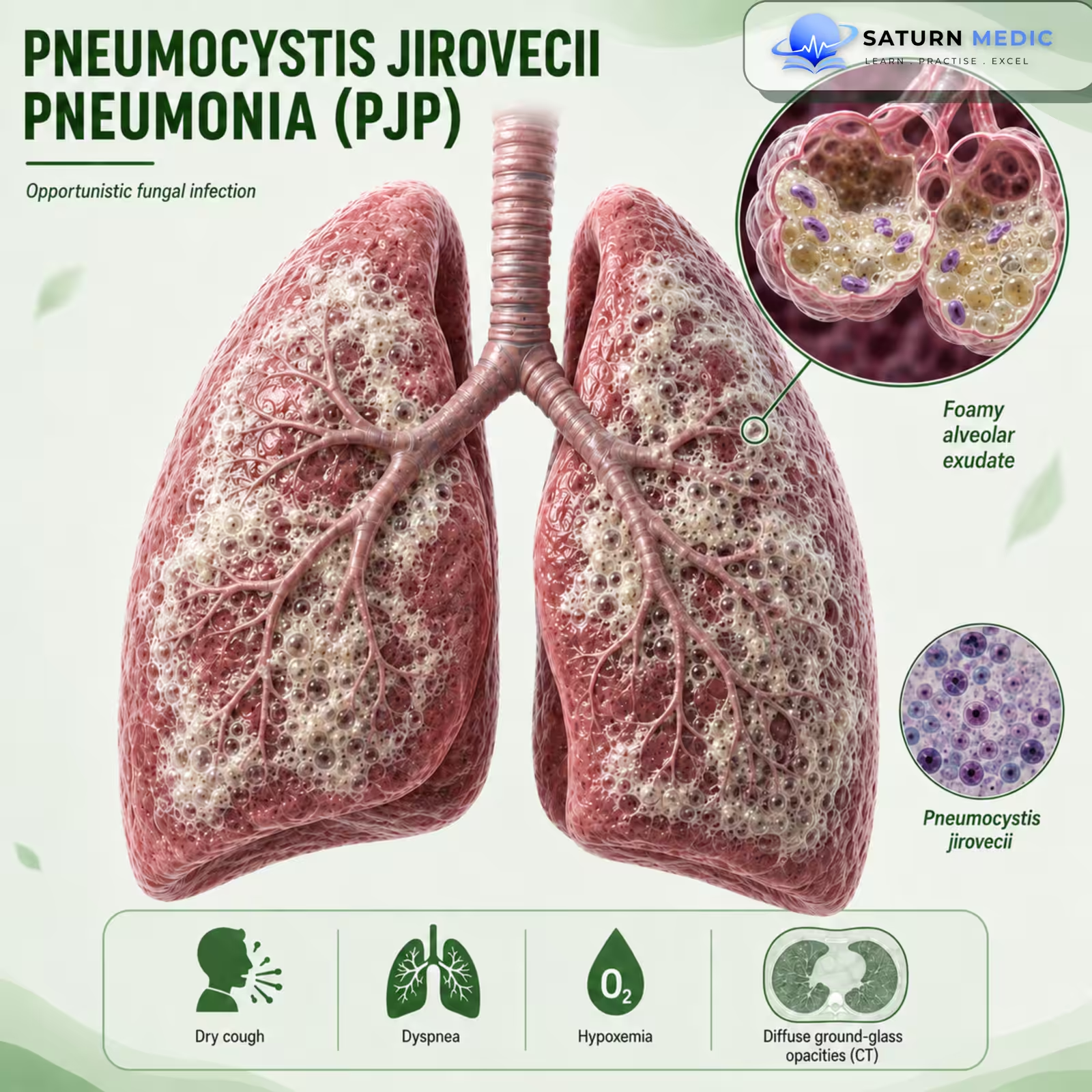
Diffuse alveolar inflammation → Impaired gas exchange → Progressive hypoxemia
Etiology & Risk Factors
-Cause
- Pneumocystis jirovecii
-Risk Factors
- HIV/AIDS (especially CD4 <200 cells/μL)
- Prolonged corticosteroid therapy
- Organ transplantation
- Hematologic malignancies
- Chemotherapy
- Immunosuppressive medications
- Primary immunodeficiency
Important Note
Pneumocystis Pneumonia (PJP) should always be suspected in immunocompromised patients with progressive dyspnea, dry cough, and hypoxemia.
Pathophysiology
Immunosuppression
⬇
Pneumocystis jirovecii infection
⬇
Diffuse alveolar colonization
⬇
Alveolar inflammation
⬇
Protein-rich foamy alveolar exudate
⬇
Impaired oxygen diffusion
⬇
Progressive hypoxemia
⬇
Respiratory failure (severe disease)
Key Concept
PJP causes diffuse alveolar injury resulting in severe hypoxemia rather than focal lobar consolidation.
Clinical Presentation
Symptoms
Progressive dyspnea
Dry cough
Fever
Fatigue
Reduced exercise tolerance
Chest discomfort
Signs
Tachypnea
Tachycardia
Reduced oxygen saturation
Fine inspiratory crackles (may be absent)
Severe Disease
Marked hypoxemia
Cyanosis
Respiratory distress
Respiratory failure
History Taking
-Ask about:
- HIV infection?
- CD4 count?
- Organ transplantation?
- Long-term corticosteroid use?
- Immunosuppressive medications?
- Progressive shortness of breath?
- Dry cough?
- Fever?
- Weight loss?
- Previous PJP?
- PJP prophylaxis?
Physical Examination
-General Examination
Look for:
- Fever
- Tachypnea
- Tachycardia
- Hypoxemia
- Cyanosis
-Chest Examination
May show:
- Fine inspiratory crackles
- Normal examination in early disease
Investigations of Pneumocystis Pneumonia (PJP)
-Chest Imaging
Chest X-ray
May show:
Diffuse bilateral interstitial or perihilar infiltrates
May be normal early in the disease.
High-Resolution CT (HRCT)
May show:
Diffuse bilateral ground-glass opacities
Interstitial infiltrates
Pulmonary cysts (occasionally)
-Laboratory Tests
CBC
LDH (often elevated)
HIV testing when appropriate
Arterial blood gas
-Microbiological Diagnosis
Obtain respiratory specimens for:
PCR for Pneumocystis jirovecii
Microscopy with special stains
Bronchoalveolar lavage (BAL) if sputum is nondiagnostic
Diagnosis of Pneumocystis Pneumonia (PJP)
1. Compatible Clinical Features
- Progressive dyspnea
- Dry cough
- Fever
2. Compatible Imaging
- Bilateral diffuse infiltrates
- Ground-glass opacities
3. Microbiological Confirmation
Using:
- PCR
- Microscopy
- Bronchoalveolar lavage specimens
Important Note
Definitive diagnosis requires identification of Pneumocystis jirovecii in respiratory specimens.
Related Topics
Management of Pneumocystis Pneumonia (PJP)
-Main Goals
Eradicate infection
Improve oxygenation
Prevent respiratory failure
Treat underlying immunosuppression
-First-Line Therapy
Trimethoprim-sulfamethoxazole (TMP-SMX)
-Adjunctive Corticosteroids
Recommended for moderate-to-severe PJP with significant hypoxemia.
-Supportive Management
Oxygen therapy
Mechanical ventilation if required
Optimize treatment of the underlying immunodeficiency
-Prevention
TMP-SMX prophylaxis is recommended for high-risk patients (e.g., HIV with CD4 <200 cells/μL).
Complications of Pneumocystis Pneumonia (PJP)
- Acute respiratory failure
- Acute respiratory distress syndrome (ARDS)
- Pneumothorax
- Secondary bacterial infection
- Mechanical ventilation
- Death
Prognosis of Pneumocystis Pneumonia (PJP)
- Prognosis is excellent with early diagnosis and treatment.
- Delayed diagnosis increases mortality.
- Prognosis is worse in:
- Severe hypoxemia
- Delayed treatment
- Non-HIV immunocompromised patients
- Appropriate prophylaxis markedly reduces the incidence of PJP.
Key Points / Clinical Pearls
- Pneumocystis jirovecii pneumonia (PJP) is an opportunistic fungal pneumonia caused by Pneumocystis jirovecii.
- It occurs mainly in immunocompromised patients, especially those with HIV/AIDS (CD4 <200 cells/μL).
- Progressive dyspnea, dry cough, fever, and hypoxemia are classic features.
- HRCT typically shows diffuse bilateral ground-glass opacities.
- Chest X-ray may be normal early in the disease.
- PCR or microscopy of respiratory specimens confirms the diagnosis.
- TMP-SMX is the first-line treatment and prophylaxis.
- Adjunctive corticosteroids are indicated in moderate-to-severe PJP with hypoxemia.
- Pneumothorax is a recognized complication of PJP.
- Truong J, Ashurst JV. National Center for Biotechnology Information (NIH). Pneumocystis Jirovecii Pneumonia, StatPearls.
- Melendez Rivera JG, Ciofoaia GA. National Center for Biotechnology Information (NIH). Pneumocystis Jirovecii Prophylaxis, StatPearls.
- White PL, Backx M, Barnes RA. Diagnosis and Management of Pneumocystis Jirovecii Infection. Expert Rev Anti Infect Ther. 2017. PMID: 28282726.
- Salzer HJF, Schafer G, Hoenigl M, et al. Clinical, Diagnostic, and Treatment Disparities Between HIV-Infected and Non-HIV-Infected Immunocompromised Patients with Pneumocystis Jirovecii Pneumonia. Respiration. 2018. PMID: 29635246.
- MedlinePlus, National Library of Medicine (NIH). Pneumocystis Jiroveci Pneumonia: Medical Encyclopedia.
Practice Pneumocystis jirovecii Pneumonia (PJP) questions
Lock in what you just read with exam-style MCQs and active-recall flashcards from Saturn Medic.