
Clinical Subject Page

Priapism
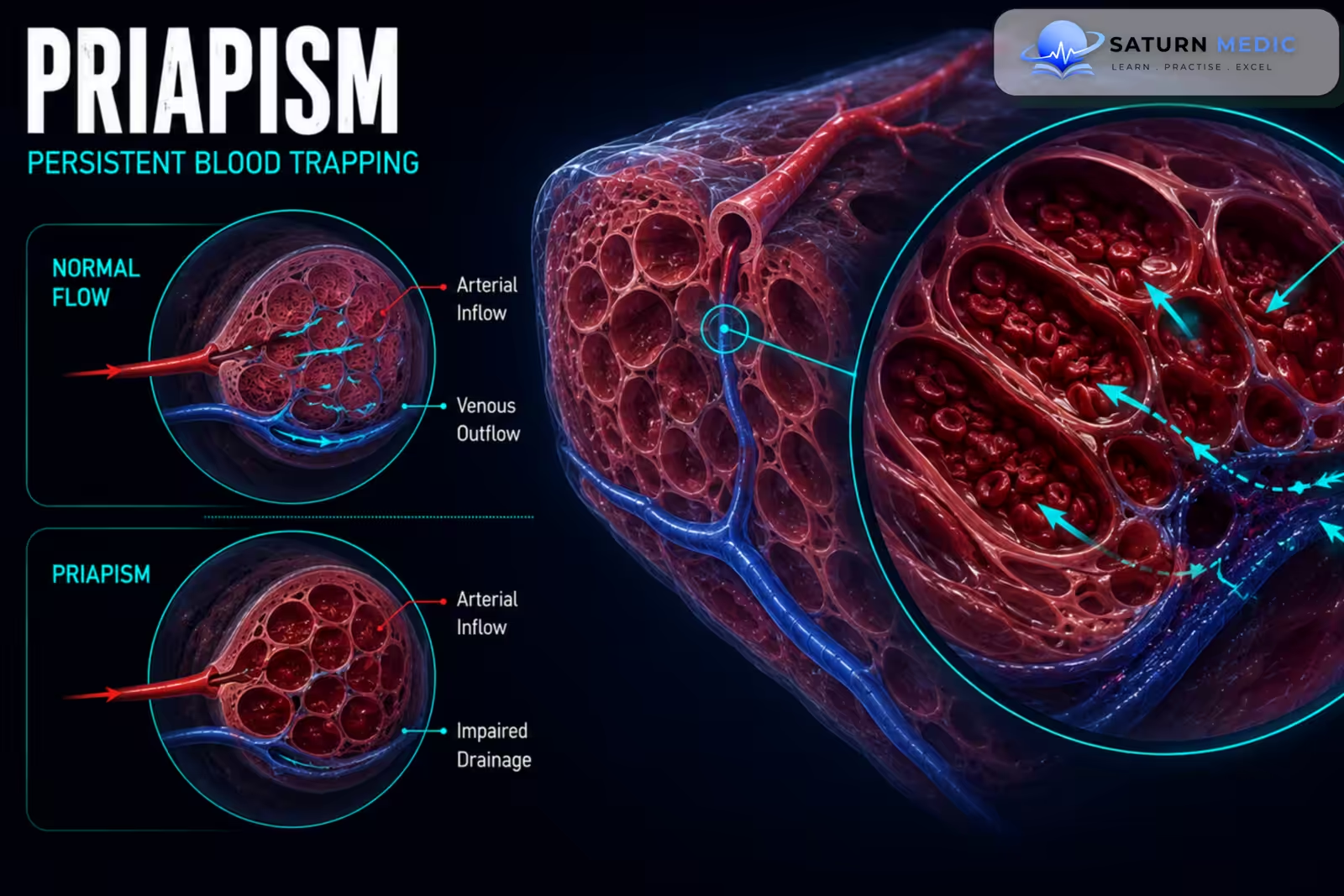
Priapism is a prolonged penile erection lasting more than 4 hours that is unrelated to sexual stimulation or does not resolve after stimulation ends. It is a urological emergency when caused by impaired venous drainage because delayed treatment can result in permanent erectile dysfunction
Also called
ICD-10
Specialty
Onset
Reviewed
-
OverviewOverview
-
Etiology & Risk FactorsEtiology & Risk Factors
-
PathophysiologyPathophysiology
-
Clinical PresentationClinical Presentation
-
History TakingHistory Taking
-
Physical ExaminationPhysical Examination
-
InvestigationsInvestigations
-
DiagnosisDiagnosis
-
ManagementManagement
-
ComplicationsComplications
-
PrognosisPrognosis
-
Key Points / Clinical PearlsKey Points / Clinical Pearls
Overview
–Priapism is classified into two main types:
- Ischemic priapism (low-flow): Reduced venous outflow causes blood to become trapped in the corpora cavernosa. It is painful, rigid, and a urological emergency.
- Non-ischemic priapism (high-flow): Usually occurs after perineal or penile trauma causing abnormal arterial inflow. It is usually less painful and not fully rigid.
A recurrent form, sometimes called stuttering priapism, consists of repeated episodes of prolonged erections.
Etiology & Risk Factors
-Etiology
–Ischemic Priapism
Causes include:
- Sickle cell disease and other hematological disorders
- Intracavernosal erectile dysfunction medications
- Antipsychotic medications
- Antidepressants
- Other medications or recreational substances in some cases
- Malignancy
- Neurological disorders
- Idiopathic causes
-Non-Ischemic Priapism
Usually caused by:
- Perineal trauma
- Penile trauma
- Arterial injury causing an arteriocavernosal fistula
-Risk Factors
- Sickle cell disease
- Previous priapism
- Intracavernosal injection therapy
- Certain psychotropic medications
- Penile or perineal trauma
Pathophysiology
-Ischemic Priapism
Failure of venous outflow → blood trapped within the corpora cavernosa → reduced oxygen delivery → hypoxia and acidosis → smooth-muscle ischemia → tissue damage → fibrosis → erectile dysfunction.
-Non-Ischemic Priapism
Penile or perineal trauma → arterial injury → uncontrolled arterial inflow into the corpora cavernosa → persistent erection without significant ischemia
Clinical Presentation
–Symptoms
Ischemic Priapism:
- Painful prolonged erection
- Erection lasting more than 4 hours
- No relation to sexual stimulation
- Increasing penile pain with prolonged duration
Non-Ischemic Priapism:
- Persistent erection
- Usually little or no pain
- History of penile or perineal trauma
-Signs:
Ischemic Priapism:
- Fully rigid corpora cavernosa
- Pain and tenderness
- Glans penis may remain relatively soft
Non-Ischemic Priapism
- Partially rigid erection
- Usually non-tender
- Less rigid than ischemic priapism
Severe Disease
- Severe penile pain
- Prolonged ischemia
- Cavernosal tissue necrosis
History Taking
-Ask about:
- Exact duration of the erection
- Severity of pain
- Previous episodes
- Recent sexual activity
- Penile or perineal trauma
- Sickle cell disease or other hematological disorders
- Use of erectile dysfunction medications
- Intracavernosal injections
- Antipsychotic or antidepressant medications
- Recreational drug use
Physical Examination
-General Examination
- Assess pain and vital signs
- Look for signs of underlying systemic disease
- Assess for trauma
-System-Specific Examination:
- Assess rigidity of the corpora cavernosa
- Assess whether the glans is soft or rigid
- Examine for penile or perineal trauma
- Assess tenderness
- Look for signs of infection or malignancy when clinically indicated
Investigations
-Complete Blood Count
Relevant when an underlying hematological disorder, malignancy, or other systemic cause is suspected.
-Peripheral Blood Film
May be indicated when a hematological disorder is suspected.
-Biochemistry / Specific Tests
Blood tests directed at suspected underlying causes
Testing for sickle cell disease when clinically indicated
-Imaging
Penile Color Doppler Ultrasound
Useful when the diagnosis is uncertain, particularly for distinguishing ischemic from non-ischemic priapism.
It may demonstrate:
Minimal or absent cavernosal arterial flow in ischemic priapism
Increased arterial flow or an arteriocavernosal fistula in non-ischemic priapism
-Special / Confirmatory Tests
Cavernosal Blood Gas Analysis:
A key test for distinguishing ischemic from non-ischemic priapism.
Diagnosis
-Diagnosis is based on:
A prolonged erection lasting more than 4 hours + assessment of pain and rigidity + cavernosal blood gas analysis when needed to distinguish ischemic from non-ischemic priapism.
A painful, fully rigid penis strongly suggests ischemic priapism.
Penile Doppler ultrasound is particularly useful when non-ischemic priapism is suspected.
Management
1. First-Line / Emergency Management
Ischemic priapism requires immediate emergency treatment.
Initial management includes:
Analgesia
Local or penile block when required
Aspiration of blood from the corpora cavernosa
Intracavernosal administration of an appropriate sympathomimetic agent, commonly phenylephrine
Continuous monitoring during sympathomimetic treatment
The underlying cause should also be investigated and treated.
2. Definitive Treatment
For ischemic priapism that does not resolve with aspiration and intracavernosal medication:
Surgical shunting procedures may be required
More advanced surgical approaches may be considered in prolonged cases with significant tissue injury
For non-ischemic priapism:
Observation may be appropriate in selected cases
Persistent cases may require selective arterial embolization
3. Medical Treatment
Treatment depends on the underlying cause and may include:
Intracavernosal sympathomimetic therapy for ischemic priapism
Treatment of underlying hematological disease
Review and discontinuation of causative medication when appropriate
Preventive treatment for recurrent priapism in selected patients
4. Surgical / Procedural Treatment
Ischemic Priapism
Cavernosal aspiration and irrigation
Surgical shunt if conservative measures fail
Penile prosthesis may be considered in selected prolonged cases with severe irreversible erectile tissue damage
Non-Ischemic Priapism
Selective arterial embolization for persistent symptomatic cases
5. Supportive Management
Adequate pain control
Urological follow-up
Investigation of underlying causes
Complications
- Erectile dysfunction
- Corporal fibrosis
- Penile pain
- Recurrent priapism
- Penile deformity
- Psychological distress
Prognosis
The prognosis depends mainly on the type and duration of priapism. Non-ischemic priapism generally has a better prognosis because significant tissue ischemia does not usually occur. In ischemic priapism, the risk of permanent erectile dysfunction increases substantially as the duration of the episode increases. Early treatment offers the best chance of preserving erectile function.
Key Points / Clinical Pearls
- Priapism is a prolonged erection lasting more than 4 hours.
- Ischemic priapism is a urological emergency.
- Ischemic priapism is usually painful and fully rigid.
- Non-ischemic priapism is usually less painful and less rigid.
- Sickle cell disease is an important cause of ischemic priapism.
- Intracavernosal erectile dysfunction medication can cause priapism.
- Perineal trauma is a classic cause of non-ischemic priapism.
- Cavernosal blood gas analysis helps distinguish the two main types.
- Ischemic priapism produces hypoxic, hypercapnic, and acidic cavernosal blood.
- Penile Doppler ultrasound is useful when non-ischemic priapism is suspected.
- Initial treatment of ischemic priapism includes aspiration and intracavernosal sympathomimetic therapy.
- Phenylephrine is commonly used for ischemic priapism.
- European Association of Urology (EAU). EAU Guidelines on Sexual and Reproductive Health .
- American Urological Association (AUA) and Sexual Medicine Society of North America (SMSNA). Acute Ischemic Priapism: AUA/SMSNA Guideline .
- Burnett AL, Bivalacqua TJ, Priapism Guideline Panel. Acute Ischemic Priapism: An AUA/SMSNA Guideline . J Urol.
- Montague DK, Jarow J, Broderick GA, et al. American Urological Association Guideline on the Management of Priapism. J Urol. 2003;170(4 Pt 1):1318-1324. PubMed .
- Broderick GA, Kadioglu A, Bivalacqua TJ, et al. Priapism: Pathogenesis, Epidemiology, and Management. J Sex Med. 2010;7(1 Pt 2):476-500. Journal of Sexual Medicine .
- National Library of Medicine (NIH). Priapism . StatPearls.