
Also called
ICD-10
Specialty
Onset
Reviewed
-
OverviewOverview
-
Etiology & Risk FactorsEtiology & Risk Factors
-
PathophysiologyPathophysiology
-
Clinical PresentationClinical Presentation
-
History TakingHistory Taking
-
Physical ExaminationPhysical Examination
-
InvestigationsInvestigations
-
DiagnosisDiagnosis
-
ManagementManagement
-
ComplicationsComplications
-
PrognosisPrognosis
-
Key Points / Clinical PearlsKey Points / Clinical Pearls
Overview
- Most common in infants and young children, and is usually idiopathic (no clear cause).
Typical symptoms include:
- Sudden, colicky (intermittent) abdominal pain
- Intermittent vomiting
- Child drawing the knees up to the chest
- Sometimes blood in the stool and a palpable abdominal mass
- Ultrasound is the preferred diagnostic test in children.
Etiology & Risk Factors
-Etiology
- Idiopathic (most common in children, ~90%)
- No identifiable cause.
- Often follows a viral illness (e.g., adenovirus), with enlarged Peyer patches acting as a temporary lead point.
- Pathological lead point
- Children (uncommon): Meckel diverticulum (most common), intestinal polyps, benign tumors, lymphoma, hematoma, hemangioma.
Adults (common): Usually caused by a neoplasm (tumor); other causes include infections, postoperative adhesions, Crohn disease, and congenital abnormalities.
-Risk Factors
- Age 3–12 months (highest risk in children)
- Recent viral illness
- Children > 5 years or recurrent intussusception (more likely to have a pathological lead point)
- Meckel diverticulum
- Cystic fibrosis
- IgA vasculitis (Henoch-Schönlein purpura)
- Intestinal tumors or polyps (especially in adults)
Pathophysiology
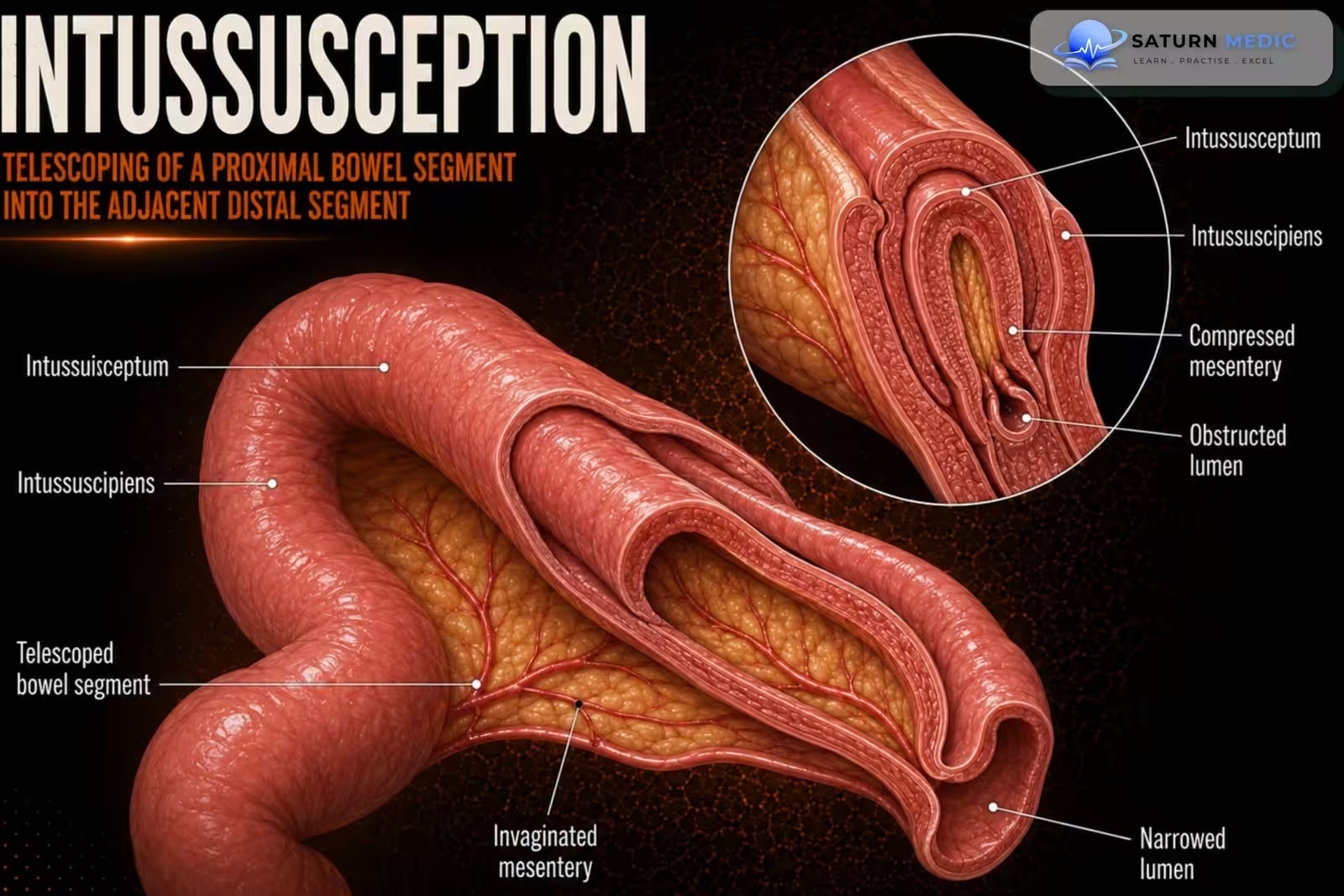
Lead point or enlarged Peyer patches → Intestinal telescoping (intussusception) → Bowel obstruction → Lymphatic obstruction → Venous congestion → Bowel wall edema → Reduced arterial blood flow → Intestinal ischemia → Necrosis (if untreated) → Perforation → Peritonitis
Clinical Presentation
-
Symptoms
- Sudden intermittent (colicky) abdominal pain
- Child draws knees to the chest during pain episodes
- Vomiting (may become bilious with bowel obstruction)
- Bloody or “currant jelly” stool (late sign, suggests bowel ischemia)
- Restlessness, irritability, or lethargy
Physical signs
- Abdominal tenderness
- Palpable sausage-shaped abdominal mass (usually in the right upper quadrant or epigastrium)
- Abnormal bowel sounds (high-pitched early, absent late)
History Taking
-
Ask about:
- When did the abdominal pain start?
- Is the pain intermittent (comes and goes) or constant?
- Does the child pull the knees to the chest during pain?
- Has the child been vomiting? Is it green (bilious)?
- Have you noticed blood or mucus in the stool?
- Has the child had diarrhea or constipation?
- Is the child irritable, restless, or unusually sleepy (lethargic)?
- Has the child had a recent viral illness (fever, cough, or cold)?
- Has this happened before?
- Does the child have any known bowel disease or previous abdominal surgery?
Physical Examination
- Assess vital signs (fever, tachycardia, signs of shock)
- Inspect the abdomen for distension
- Palpate for abdominal tenderness
- Feel for a sausage-shaped abdominal mass (usually in the right upper quadrant or epigastrium)
- Look for Dance sign (empty right lower quadrant; uncommon)
- Auscultate for high-pitched bowel sounds early or absent bowel sounds late
- Examine the stool for blood or “currant jelly” stool
Investigations
-
Laboratory Tests
- CBC – assess anemia or infection
- BMP (electrolytes) – assess dehydration and electrolyte imbalance
- Lactate – evaluate for bowel ischemia
Imaging
- Ultrasound abdomen (preferred in children)
- Target sign (concentric rings)
- Pseudokidney sign
- CT abdomen (preferred in adults)
- Target sign
- Detects lead point (e.g., tumor)
- Assesses for bowel ischemia
- Image-guided enema
- Used if diagnosis is uncertain and/or for reduction
- Contraindicated if bowel perforation is suspected
- Abdominal X-ray
- Not the initial test
- May show distended bowel loops if performed
Diagnosis
-
Diagnosis is based on clinical suspicion and confirmed with imaging.
- Children: Ultrasound abdomen (preferred)
- Target sign
- Pseudokidney sign
- Adults: CT abdomen (preferred)
- Target sign
- Identifies a pathological lead point and bowel ischemia
- Image-guided enema
- Used if diagnosis is uncertain and/or for reduction
- Do not use if bowel perforation is suspected
- Children: Ultrasound abdomen (preferred)
Related Topics
Management
-
Initial Management
- ABCDE assessment
- NPO (nothing by mouth)
- IV fluids for resuscitation
- Pain management
- Consider NG tube for gastric decompression
- Antibiotics if bowel ischemia or perforation is suspected
- Urgent surgical and/or radiology consultation
Definitive Treatment
- Clinically stable children:
- Image-guided pneumatic or hydrostatic enema reduction (first-line)
- Surgery if:
- Enema reduction fails
- Bowel perforation or intestinal ischemia is suspected
- Pathological lead point is present
- Most adult cases
After Successful Reduction
- Observe the child.
- Discharge if stable, asymptomatic, and tolerating oral fluids after observation.
- Admit if symptoms persist, reduction is unsuccessful, or risk factors for recurrence/complications are present.
Complications
- Bowel obstruction – blockage of intestinal contents.
- Intestinal ischemia – reduced blood supply leading to bowel injury.
- Bowel necrosis – death of bowel tissue if ischemia is prolonged.
- Gastrointestinal (bowel) perforation – rupture of the bowel wall.
- Peritonitis – inflammation/infection of the abdominal cavity after perforation.
- Recurrence – intussusception can recur after successful reduction.
Prognosis
- Intussusception is the telescoping of one part of the intestine into another.
- It is the most common cause of bowel obstruction in infants and young children.
- Most cases in children are idiopathic; adults usually have a pathological lead point (e.g., tumor).
- Classic symptoms: intermittent colicky abdominal pain, vomiting, and knees drawn to the chest.
- Currant jelly stool is a late sign and suggests bowel ischemia.
- Ultrasound is the diagnostic test of choice in children.
- CT abdomen is the diagnostic test of choice in adults.
- Pneumatic or hydrostatic enema is the first-line treatment in stable children.
- Surgery is required if enema reduction fails, perforation or ischemia is suspected, or in most adults.
Key Points / Clinical Pearls
- Vascular emergency with high mortality (50–70%).
- Most common cause: Superior mesenteric artery (SMA) embolism.
- Most important risk factor: Atrial fibrillation.
- Hallmark symptom: Severe abdominal pain out of proportion to the physical examination.
- Classic triad: Severe abdominal pain + bloody diarrhea + atrial fibrillation.
- CT angiography (CTA) is the test of choice.
- Do not delay CTA while waiting for laboratory results.
- Normal lactate does not exclude acute mesenteric ischemia early in the disease.
- Initial treatment: ABCDE, oxygen, IV fluids, NPO, NG tube, IV antibiotics, IV heparin (if appropriate), urgent surgical/vascular consultation.
- Peritonitis or hemodynamic instability = emergency laparotomy
- National Center for Biotechnology Information (NIH). Child Intussusception, StatPearls.
- Qiang H, Fu M, Feng S, et al. Repeated Ultrasound-Guided Hydrostatic Reduction for Pediatric Intussusception: Attempt Number, Interval, and Success. Eur J Med Res. 2025. PMID: 41291924.
- MedlinePlus, National Library of Medicine (NIH). Intussusception: Medical Encyclopedia.
- Determinants of Ultrasound-Guided Reduction Failure and Pathological Lead Points in Pediatric Intussusception. Pediatr Surg Int. 2025. PMC12909316.
- Gfroerer S, Fiegel H, Rolle U. Twenty Years' Experience for Reduction of Ileocolic Intussusceptions by Saline Enema Under Sonography Control. Pediatr Surg Int. 2016;32:679-682. PMID: 27154198.
Practice Intussusception questions
Lock in what you just read with exam-style MCQs and active-recall flashcards from Saturn Medic.