
Also called
ICD-10
Specialty
Onset
Reviewed
-
OverviewOverview
-
Etiology & Risk FactorsEtiology & Risk Factors
-
PathophysiologyPathophysiology
-
Clinical PresentationClinical Presentation
-
History TakingHistory Taking
-
Physical ExaminationPhysical Examination
-
InvestigationsInvestigations
-
DiagnosisDiagnosis
-
ManagementManagement
-
ComplicationsComplications
-
PrognosisPrognosis
-
Key Points / Clinical PearlsKey Points / Clinical Pearls
What is Central Diabetes Insipidus?
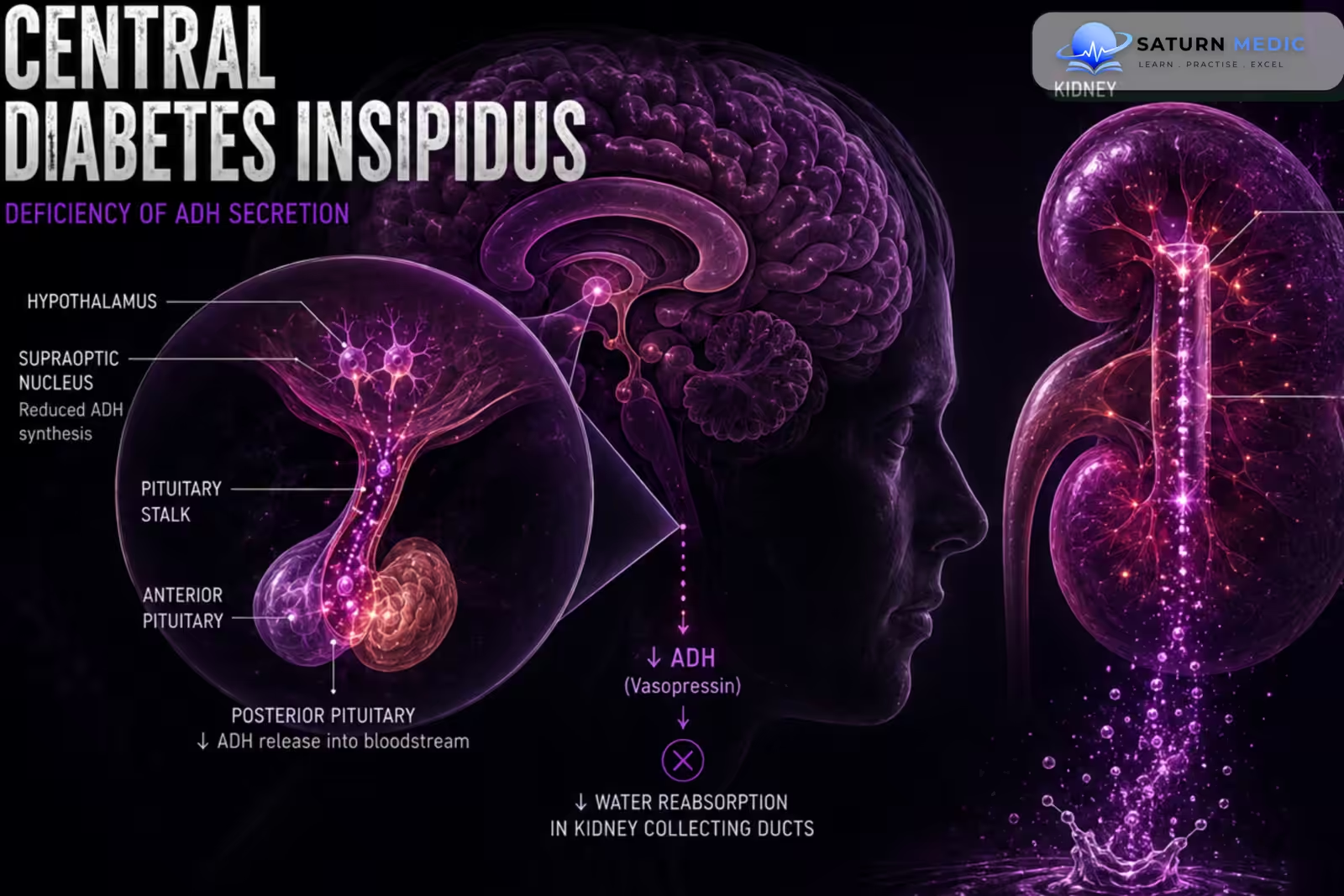
• Central Diabetes Insipidus occurs when inadequate ADH secretion prevents the kidneys
from concentrating urine.
• Patients typically develop large volumes of dilute urine and excessive thirst.
• Common causes include pituitary or hypothalamic surgery, head trauma, tumors, and autoimmune or inflammatory disorders.
Etiology & Risk Factors
-Common Causes
1. Surgery
• Pituitary surgery
• Hypothalamic surgery
2. Head Trauma
• Traumatic brain injury
• Skull-base injury
3. Tumors
• Craniopharyngioma
• Pituitary tumors
• Hypothalamic tumors
4.Inflammatory/Autoimmune Disorders
• Autoimmune hypophysitis
• Langerhans cell histiocytosis
5. Vascular Causes
• Cerebral ischemia
• Hemorrhage
6. Infections
• Meningitis
• Encephalitis
-Risk Factors
• Previous pituitary or hypothalamic surgery
• Head trauma
• Pituitary tumors
• Autoimmune disease
• Inflammatory disorders
• Central nervous system infections
Pathophysiology
Hypothalamic/posterior pituitary damage
→ ↓ ADH (vasopressin) secretion
→ ↓ ADH action on renal collecting ducts
→ ↓ Aquaporin-2 water channels
→ ↓ Renal water reabsorption
→ Excessive free-water loss
→ Large volumes of dilute urine
→ ↑ Plasma osmolality
→ ↑ Serum sodium
→ Intense thirst → Polydipsia
Clinical Presentation
-Symptoms:
• Excessive urination (polyuria)
• Excessive thirst (polydipsia)
• Nocturia
• Frequent nighttime urination
• Preference for cold water
• Dry mouth
Patients may produce:
• Several liters of urine per day
• Very dilute urine
-Signs:
• Dehydration
• Dry mucous membranes
• Tachycardia
• Postural hypotension
• Weight loss from water loss
History Taking
-Ask about:
• Onset and duration of polyuria
• Amount of urine produced per day
• Nocturia
• Excessive thirst
• Water intake
• Preference for cold water
• Symptoms of dehydration
• Weight loss
• Headaches
• Visual disturbances
• Previous pituitary surgery
• Previous brain surgery
• Head trauma
Physical Examination
-General Examination:
• Assess hydration status
• Measure blood pressure
• Check for postural hypotension
• Measure heart rate
• Assess body weight
System-Specific Examination
-Neurological Examination
Look for:
• Headache
• Visual field defects
• Altered mental status
-Endocrine Examination
• Look for signs of associated pituitary hormone deficiencies.
Investigations
-Serum Sodium
May show:
• Normal sodium in patients with adequate water intake
-Serum Osmolality
Usually:
• Increased Urine Osmolality
Typically:
• Low
• Despite increased plasma osmolality, the kidneys produce inappropriately dilute urine.
-Urine Specific Gravity
• Low
-Renal Function
• Urea and creatinine may increase with severe dehydration.
-Glucose
• Important to exclude diabetes mellitus as a cause of polyuria
-Imaging
Magnetic Resonance Imaging (MRI) of the
Hypothalamic-Pituitary
Region
• Used to identify the underlying cause.
May demonstrate:
• Pituitary or hypothalamic tumor
• Pituitary stalk abnormalities
• Inflammatory disease
Special / Confirmatory Tests
-Water Deprivation Test
• Assesses the ability of the kidneys to concentrate urine when water intake is restricted.
-In Central Diabetes Insipidus:
• Urine remains inappropriately dilute.
-Desmopressin Challenge
• Desmopressin is administered after water deprivation
-In Central Diabetes Insipidus:
• Urine osmolality increases significantly.
• Urine becomes more concentrated.
-In Nephrogenic Diabetes Insipidus:
• There is little or no response.
Diagnosis
-Diagnosis is based on:
• Polyuria and polydipsia
• High or high-normal serum sodium/osmolality
• Inappropriately dilute urine
• Evidence of deficient ADH secretion
• Significant increase in urine concentration after desmopressin
Management
1. Definitive Treatment
• Desmopressin
• The main treatment for Central Diabetes Insipidus.
• It is a synthetic analogue of ADH.
Effects:
• Increases renal water reabsorption
saturnmedic.com Central Diabetes Insipidus 8
• Reduces urine volume
• Increases urine concentration
• Reduces thirst and excessive water loss
-Available as:
• Oral tablets
• Intranasal preparation
• Injectable preparation
• Choice depends on the clinical situation.
-Treat the Underlying Cause
Examples:
• Pituitary tumor management
• Treatment of inflammatory disease
• Management of infection
• Appropriate treatment following traumatic brain injury
2. Surgical / Procedural Treatment
• Surgery is not used to treat Central Diabetes Insipidus itself.
However, surgery may be required for the underlying cause, such as:
• Pituitary tumor
• Craniopharyngioma
• Other hypothalamic lesions
3. Supportive Management
• Ensure adequate access to water
• Monitor serum sodium
• Monitor urine output
• Monitor fluid balance
Complications
• Severe dehydration
• Hypernatremia
• Hypovolemia
• Hypotension
• Acute kidney injury
• Neurological complications
• Seizures
• Coma
Prognosis
• The prognosis is generally good when Central Diabetes Insipidus is appropriately diagnosed and treated with desmopressin.
• Many patients require long-term or lifelong treatment, particularly when permanent hypothalamic or posterior pituitary damage has occurred.
Key Points / Clinical Pearls
• Central Diabetes Insipidus is caused by deficient ADH (vasopressin) secretion.
• It causes excessive loss of free water through the kidneys.
• The classic symptoms are polyuria and polydipsia.
• Urine is typically very dilute.
• Serum osmolality is usually increased.
• Serum sodium may be elevated, especially when water intake is inadequate.
• Common causes include pituitary surgery, head trauma, tumors, and inflammatory disease.
• Diabetes mellitus should be excluded in patients with polyuria.
• MRI of the hypothalamic-pituitary region helps identify the underlying cause.
• Water deprivation testing may demonstrate impaired urine concentration.
• Desmopressin produces a marked increase in urine concentration in Central Diabetes
Insipidus.
• Desmopressin is the main treatment.
• Severe hypernatremia and dehydration require careful fluid replacement.
- Fenske W, Allolio B. Current State and Future Perspectives in the Diagnosis of Diabetes Insipidus: A Clinical Review. J Clin Endocrinol Metab. 2012;97(10):3426-3437.
- Christ-Crain M, Bichet DG, Fenske W, et al. Diabetes Insipidus. Nat Rev Dis Primers. 2019;5:54. Nature Reviews Disease Primers .
- Fleseriu M, Hashim IA, Karavitaki N, et al. Hormonal Replacement in Hypopituitarism in Adults: An Endocrine Society Clinical Practice Guideline. J Clin Endocrinol Metab. 2016;101(11):3888-3921. Journal of Clinical Endocrinology & Metabolism .
- National Institute of Diabetes and Digestive and Kidney Diseases (NIDDK). Diabetes Insipidus . National Institutes of Health.
- National Library of Medicine (NIH). Diabetes Insipidus . StatPearls.
Practice Central Diabetes Insipidus questions
Lock in what you just read with exam-style MCQs and active-recall flashcards from Saturn Medic.