
Also called
ICD-10
Specialty
Onset
Reviewed
-
OverviewOverview
-
Etiology & Risk FactorsEtiology & Risk Factors
-
PathophysiologyPathophysiology
-
Clinical PresentationClinical Presentation
-
History TakingHistory Taking
-
Physical ExaminationPhysical Examination
-
InvestigationsInvestigations
-
DiagnosisDiagnosis
-
ManagementManagement
-
ComplicationsComplications
-
PrognosisPrognosis
-
Key Points / Clinical PearlsKey Points / Clinical Pearls
What is Prolactinoma?
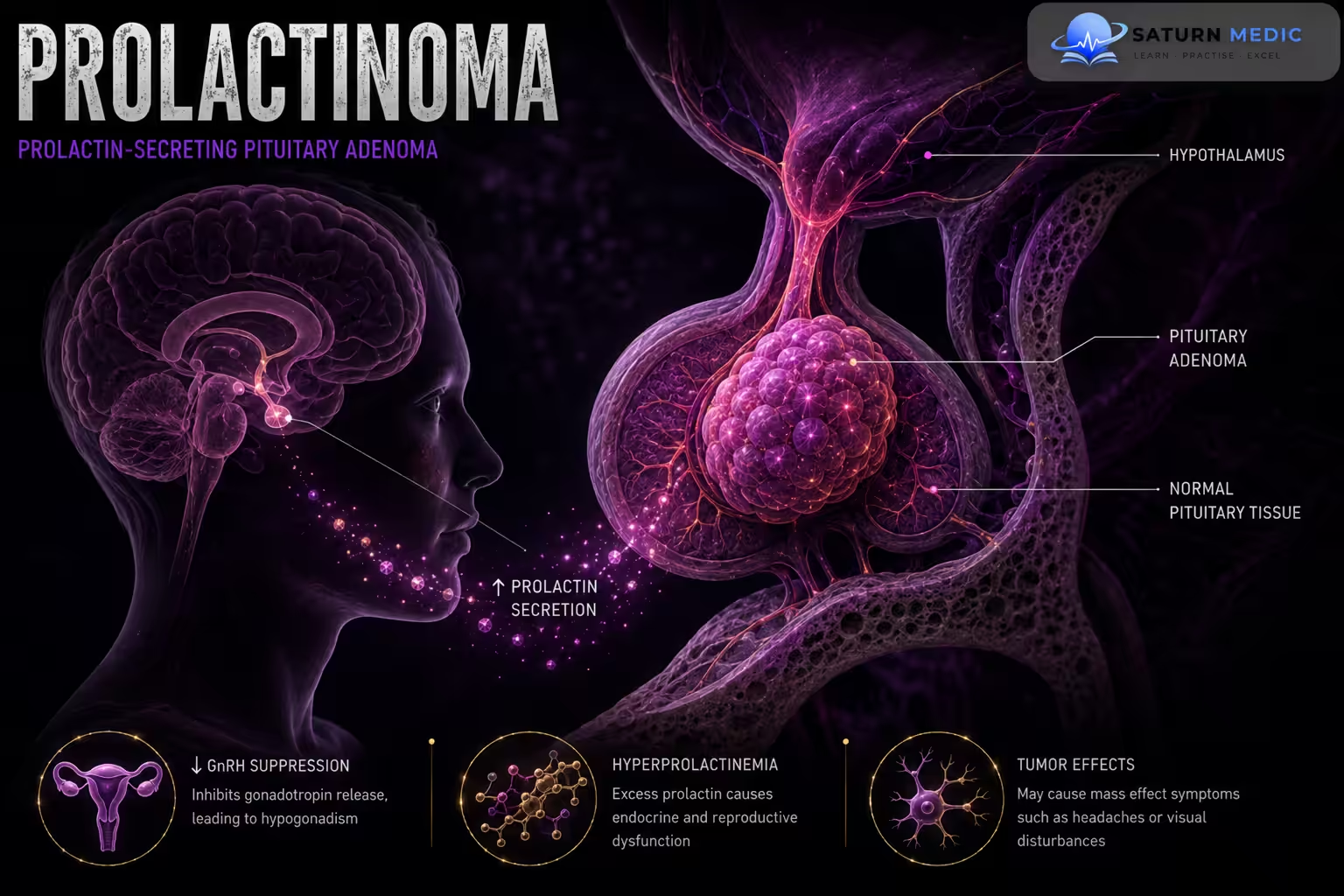
–Prolactinoma is caused by abnormal growth of prolactin-producing lactotroph cells in the anterior pituitary gland. Excess prolactin suppresses the hypothalamic-pituitary-gonadal axis, causing reduced sex hormone production and reproductive dysfunction.
–Clinical features depend on tumor size and prolactin level. Common presentations include galactorrhea, menstrual irregularities, infertility, and hypogonadism.
Etiology & Risk Factors
-Etiology:
•Prolactinoma develops due to uncontrolled proliferation of lactotroph cells in the anterior pituitary.
-The tumor causes:
•Increased prolactin secretion Suppression of gonadotropin-releasing hormone (GnRH)
•Reduced luteinizing hormone (LH) and follicle-stimulating hormone (FSH)
Reduced estrogen or testosterone production
-Types based on size:
•Microprolactinoma
Tumor size <10 mm
More common
Usually presents with hormonal symptoms
•Macroprolactinoma
Tumor size ≥10 mm
More likely to cause mass effect symptoms
-Inheritance
Most cases are sporadic.
-Risk Factors
Female sex (especially reproductive age)
Family history of pituitary tumors
Genetic endocrine tumor syndromes
Previous pituitary disorders
Pathophysiology
-Lactotroph cell mutation
→ Abnormal proliferation of pituitary lactotroph cells
→ Formation of prolactin-secreting pituitary adenoma
→ ↑ Prolactin secretion
→ ↑ Prolactin inhibits hypothalamic GnRH release
→ ↓ LH and FSH secretion
→ ↓ Estrogen/testosterone production
→ Reproductive dysfunction + infertility + sexual symptoms
-Large tumor
→ Compression of surrounding pituitary structures
→ Optic chiasm compression
→ Visual field defects + headaches
Clinical Presentation
-Symptoms:
-In Females:
•Menstrual irregularities
•Amenorrhea
•Infertility
•Galactorrhea
•Reduced libido
•Vaginal dryness
-In Males:
•Reduced libido
•Erectile dysfunction
•Infertility
•Gynecomastia (less common)
•Galactorrhea (rare)
-Symptoms of hypogonadism:
•Reduced bone density due to low sex hormones
-Signs:
•Galactorrhea
•Visual field defects
•Reduced secondary sexual characteristics
History Taking
-Ask about:
-Menstrual history
•Irregular periods
•Amenorrhea
•Pregnancy possibility
-Galactorrhea:
•Duration
•Nature
•Spontaneous or expressed
•Fertility problems
-Visual symptoms:
•Loss of peripheral vision
•Blurred vision
-Medication history:
•Antipsychotics
•Antidepressants
Physical Examination
-General Examination:
•Assess body habitus
•Look for signs of hormonal deficiency
•Assess secondary sexual characteristics
•Check for galactorrhea
-System-Specific Examination:
•Breast Examination
•Presence of galactorrhea
•Breast changes
-Neurological Examination:
•Visual field testing
•Cranial nerve examination
•Assessment of headaches
-Endocrine Examination:
Assess:
•Signs of hypogonadism
•Thyroid abnormalities
•Other pituitary hormone deficiencies
-Male Examination:
•Testicular size
•Signs of reduced androgen activity
Investigations
-Biochemistry / Specific Tests
•Serum Prolactin Level
-Main initial investigation.
•Findings:
Elevated prolactin level
Very high levels suggest prolactinoma, especially with compatible symptoms.
-Pregnancy Test
•Important in women of reproductive age.
-Thyroid Function Tests
•Especially TSH:
Hypothyroidism can cause elevated prolactin.
-Renal and Liver Function Tests
•May be assessed because impaired clearance can increase prolactin.
-Pituitary Hormone Assessment
•Evaluate for associated pituitary dysfunction:
LH and FSH
Estradiol/testosterone
Cortisol
Thyroid hormones
IGF-1
-Imaging
•Magnetic Resonance Imaging (MRI) of Pituitary
Investigation of choice.
Shows:
•Pituitary adenoma
•Tumor size
•Extension to surrounding structures
Diagnosis
-Diagnosis is established by:
1. Elevated serum prolactin level.
2. Exclusion of secondary causes:
Pregnancy
Medications
Hypothyroidism
Renal disease
3. Pituitary MRI demonstrating adenoma.
-Diagnostic findings:
•Increased prolactin
•Pituitary mass on MRI
•Symptoms of hyperprolactinemia or mass effect
Management
1. First-Line / Emergency Management
•Most cases are managed medically.
-Initial steps:
•Confirm diagnosis
•Exclude secondary causes
•Assess tumor size
•Evaluate visual fields in macroadenomas
-Emergency management may be required for:
•Visual deterioration
•Pituitary apoplexy
2. Definitive Treatment
Medical Therapy
•Dopamine agonists are the main treatment.
They:
•Reduce prolactin secretion
•Shrink tumor size
•Restore gonadal function
3. Medical Treatment
Cabergoline
•Preferred first-line therapy.
-Benefits:
•High effectiveness
•Long duration of action
•Good tumor shrinkage response
Bromocriptine
Alternative dopamine agonist.
-Used especially in:
•Pregnancy planning
•Patients unable to tolerate cabergoline
4. Surgical / Procedural Treatment
Transsphenoidal Surgery
Considered when:
•Medical therapy fails
•Patient cannot tolerate dopamine agonists
•Tumor causes persistent visual compromise despite treatment
Complications
- Hypogonadism
- Infertility
- Amenorrhea / oligomenorrhea in women.
- Erectile dysfunction and reduced libido in men.
- Galactorrhea —
- Reduced bone mineral density / osteoporosis —
- Tumor mass effect in large macroprolactinomas:
- Headache
- Visual field defects,
- bitemporal hemianopia
- Cranial nerve palsies
- Hypopituitarism
- Pituitary apoplexy
Prognosis
-Prolactinoma generally has an excellent prognosis with appropriate treatment.
Most patients respond well to dopamine agonists with:
Reduced prolactin levels
Tumor shrinkage
-Recovery of reproductive function Prognosis depends on:
Tumor size
Prolactin level
Response to medication
Presence of complications
Key Points / Clinical Pearls
- Prolactinoma is the most common functioning pituitary adenoma.
- It causes excessive prolactin secretion.
Increased prolactin suppresses GnRH, causing reduced LH and FSH. - Common symptoms include galactorrhea, infertility, and hypogonadism.
- Macroprolactinomas may cause headaches and visual field defects.
- Pregnancy and medications are important causes of high prolactin.
- Serum prolactin is the main diagnostic test.
- Pituitary MRI confirms tumor presence and size.
- Cabergoline is the preferred first-line treatment.
- Bromocriptine is an alternative dopamine agonist.
- Surgery is reserved for resistant or complicated cases.
- Melmed S, Casanueva FF, Hoffman AR, et al. Diagnosis and Treatment of Hyperprolactinemia: An Endocrine Society Clinical Practice Guideline. J Clin Endocrinol Metab. 2011;96(2):273-288. Journal of Clinical Endocrinology & Metabolism .
- Casanueva FF, Molitch ME, Schlechte JA, et al. Guidelines of the Pituitary Society for the Diagnosis and Management of Prolactinomas. Clin Endocrinol (Oxf). 2006;65(2):265-273.
- Melmed S, Bronstein MD, Chanson P, et al. A Consensus Statement on the Diagnosis and Treatment of Acromegaly Complications. Pituitary. 2013;16(3):294-302.
- Maiter D. Management of Dopamine Agonist-Resistant Prolactinoma. Neuroendocrinology. 2019;109(1):42-50.
- National Library of Medicine (NIH). Prolactinoma . StatPearls.
Practice Prolactinoma questions
Lock in what you just read with exam-style MCQs and active-recall flashcards from Saturn Medic.