
Also called
ICD-10
Specialty
Onset
Reviewed
-
OverviewOverview
-
Etiology & Risk FactorsEtiology & Risk Factors
-
PathophysiologyPathophysiology
-
Clinical PresentationClinical Presentation
-
History TakingHistory Taking
-
Physical ExaminationPhysical Examination
-
InvestigationsInvestigations
-
DiagnosisDiagnosis
-
ManagementManagement
-
ComplicationsComplications
-
PrognosisPrognosis
-
Key Points / Clinical PearlsKey Points / Clinical Pearls
What is Hypopituitarism?
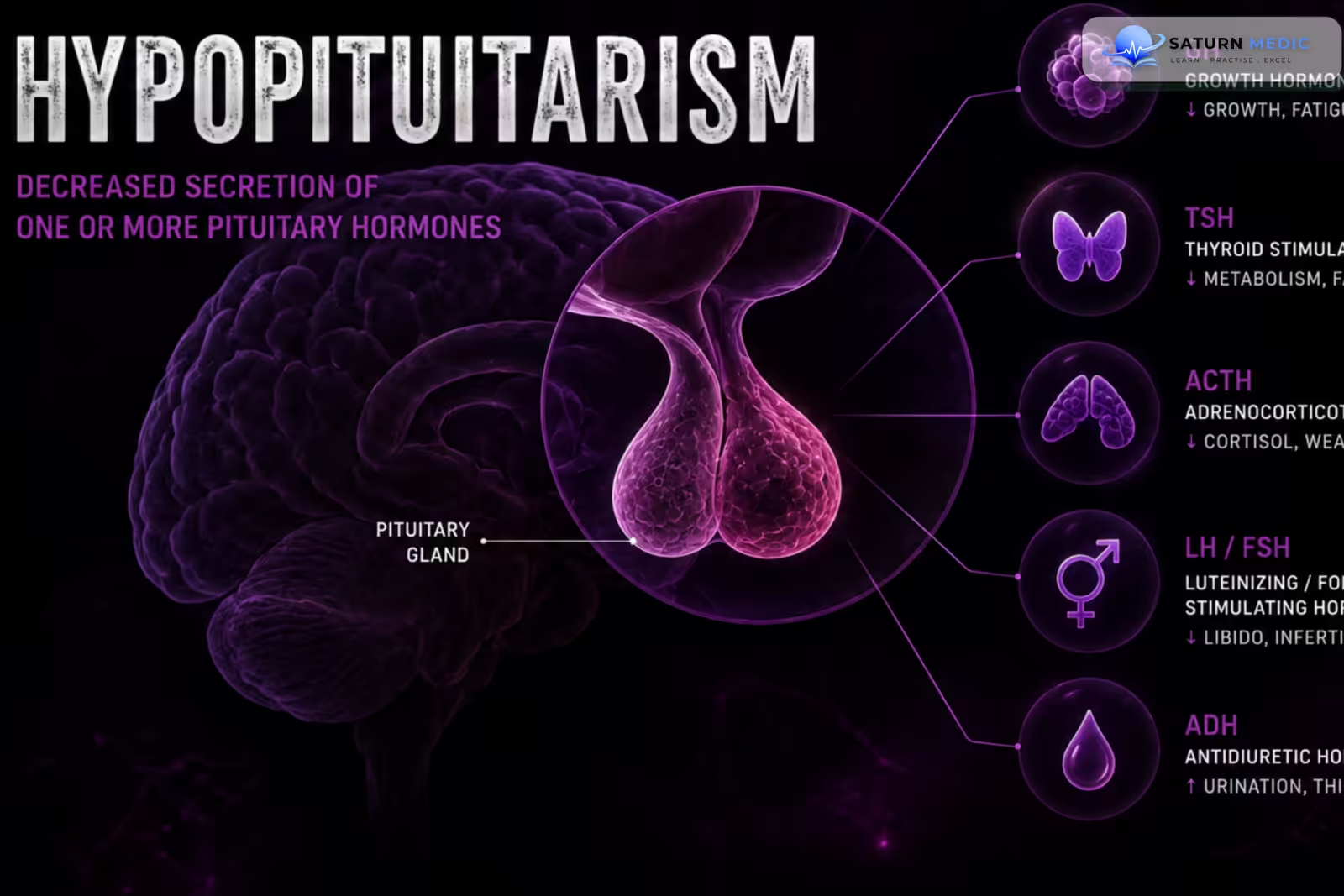
–Hypopituitarism can involve one or several pituitary hormones.
-Deficiencies may include:
• Adrenocorticotropic hormone (ACTH)
• Thyroid-stimulating hormone (TSH)
• Growth hormone (GH)
• Luteinizing hormone (LH)
• Follicle-stimulating hormone (FSH)
• Posterior pituitary dysfunction may also cause vasopressin deficiency and Central Diabetes Insipidus.
• Clinical features depend on which hormones are deficient and whether the onset is acute or gradual
Etiology & Risk Factors
-Etiology:
• Hypopituitarism can result from damage to the hypothalamus, pituitary gland, or pituitary
stalk.
Pituitary Tumors
• Pituitary adenoma
• Craniopharyngioma
• Other sellar or parasellar tumors
Surgery or Radiation
• Pituitary surgery
• Cranial radiotherapy
Vascular Causes
• Pituitary apoplexy
• Sheehan syndrome
• Other ischemic pituitary
injury
• Traumatic brain injury
Inflammatory and Infiltrative Disorders
• Lymphocytic hypophysitis
• Sarcoidosis
-Risk Factors
• Pituitary tumors
• Previous pituitary surgery
• Cranial radiotherapy
• Head trauma
• Pituitary apoplexy
Pathophysiology
Hypothalamic/pituitary damage
→ ↓ Pituitary hormone secretion
→ ↓ Stimulation of target endocrine glands
→ ↓ Target-organ hormone production
→ Hormonal deficiency
→ Impaired metabolism, growth, reproduction, stress response, and water
balance
→ Clinical features of hypopituitarism
Examples:
↓ ACTH → ↓ Cortisol → Secondary adrenal insufficiency
↓ TSH → ↓ Thyroid hormone → Central hypothyroidism
↓ LH/FSH → ↓ Sex hormones → Hypogonadism + infertility
↓ GH → ↓ IGF-1 → Reduced growth in children / altered body composition in adults
Clinical Presentation
Symptoms
• Symptoms of Hypopituitarism vary according to the affected hormones.
-ACTH Deficiency
• Fatigue
• Weakness
• Weight loss
• Nausea
-TSH Deficiency
• Fatigue
• Cold intolerance
• Weight gain
-LH/FSH Deficiency
Females:
• Amenorrhea
• Irregular menstruation
• Infertility
• Reduced libido
Males:
• Reduced libido
• Erectile dysfunction
• Infertility
• Reduced muscle mass
-Growth Hormone Deficiency
Adults:
• Reduced energy
• Increased body fat
• Reduced muscle mass
• Reduced exercise capacity
Children:
• Short stature
• Growth failure
-Signs
• Pallor
• Low blood pressure
• Bradycardia
• Reduced body hair
• Reduced secondary sexual characteristics
History Taking
-Ask about:
• Fatigue and weakness
• Weight changes
• Nausea and vomiting
• Dizziness
• Hypotension symptoms
• Cold intolerance
• Menstrual history
• Libido
• Erectile function
• Fertility
• Changes in body hair
Physical Examination
-General Examination
• Measure blood pressure
• Check for postural hypotension
• Measure heart rate
• Assess weight and BMI
• Assess hydration
• Look for pallor
• Assess body hair
• Assess secondary sexual characteristics
-System-Specific Examination
-Neurological Examination
• Visual field assessment
• Cranial nerve examination
• Assessment for headache or neurological deficits
-Endocrine Examination
Look for:
• Central hypothyroidism
• Secondary adrenal insufficiency
• Hypogonadism
• Growth hormone deficiency
-Reproductive Examination
Assess:
• Secondary sexual characteristics
• Testicular size in males
• Menstrual abnormalities in females
Investigations
-Biochemistry / Specific Tests
Morning Serum Cortisol
• Important initial assessment for ACTH deficiency.
• Low cortisol suggests adrenal insufficiency and requires further evaluation.
-ACTH:
Primary adrenal insufficiency → high ACTH
Secondary adrenal insufficiency → low or inappropriately normal ACTH
-Thyroid Function Tests
Typical pattern:
• Low free T4
• Low or inappropriately normal TSH
• This indicates central hypothyroidism.
-LH and FSH
May be:
• Low or inappropriately normal
-Sex Hormones
-Females:
• Low estradiol
-Males:
• Low testosterone
IGF-1
• May be reduced in growth hormone deficiency
Imaging
Magnetic Resonance Imaging (MRI) of the Pituitary
•Investigation of choice.
May identify:
• Pituitary adenoma
• Craniopharyngioma
• Pituitary inflammation
• Pituitary atrophy
Diagnosis
Diagnosis of Hypopituitarism is established by:
1. Identifying symptoms suggestive of pituitary hormone deficiency.
2. Measuring pituitary and target-organ hormones.
3. Performing dynamic endocrine testing when required.
4. MRI of the pituitary to identify the underlying structural cause
Management
1. First-Line / Emergency Management of Hypopituitarism
If adrenal crisis or severe ACTH deficiency is suspected:
• Give immediate glucocorticoid replacement.
• Do not delay treatment while waiting for laboratory confirmation in a critically ill patient.
• Correct hypoglycemia and fluid/electrolyte abnormalities.
• Monitor blood pressure and clinical status.
2. Definitive Treatment
Treatment involves:
1. Hormone replacement.
2. Treatment of the underlying pituitary or hypothalamic disorder.
3. Long-term endocrine monitoring.
3. Medical Treatment
-Glucocorticoid Replacement
For ACTH deficiency:
• Hydrocortisone is commonly used.
• Other glucocorticoids may be used in selected patients.
-Thyroid Hormone Replacement
For central hypothyroidism:
• Levothyroxine
-Glucocorticoid deficiency should be excluded or treated before starting levothyroxine.
-Sex Hormone Replacement
Females:
• Estrogen replacement when appropriate
• Progesterone when indicated
-Males:
• Testosterone replacement when appropriate
-Growth Hormone Replacement
• May be considered in confirmed adult or pediatric growth hormone deficiency when
appropriate.
4. Surgical / Procedural Treatment
Surgery may be required for:
• Pituitary tumors
• Craniopharyngioma
• Lesions causing visual or neurological compression
Complications
• Hyponatremia
• Hypoglycemia
• Dyslipidemia
• Secondary adrenal insufficiency
• Central hypothyroidism
• Hypogonadism
• Growth hormone deficiency
• Osteoporosis
• Reduced quality of life
• Cardiovascular risk
Prognosis
• The prognosis of Hypopituitarism depends mainly on the underlying cause, the number of deficient hormones,
and the adequacy of hormone replacement.
• With appropriate lifelong hormone replacement and monitoring, many patients can maintain a good quality of life
Key Points / Clinical Pearls
• Hypopituitarism is deficiency of one or more pituitary hormones.
• It can result from pituitary, hypothalamic, or stalk disorders.
• Common causes of Hypopituitarism include pituitary tumors, surgery, radiation, trauma, and postpartum
pituitary injury.
• ACTH deficiency causes secondary adrenal insufficiency.
• TSH deficiency causes central hypothyroidism.
• LH/FSH deficiency causes hypogonadism and infertility.
• GH deficiency causes growth failure in children and altered body composition in adults.
• ACTH deficiency can cause life-threatening adrenal crisis.
• MRI of the pituitary helps identify the underlying cause
- American Diabetes Association Professional Practice Committee. 2. Diagnosis and Classification of Diabetes: Standards of Care in Diabetes—2026. Diabetes Care. 2026;49(Suppl 1). Diabetes Care .
- American Diabetes Association Professional Practice Committee. 14. Children and Adolescents: Standards of Care in Diabetes—2026. Diabetes Care. 2026;49(Suppl 1). Diabetes Care .
- Holt RIG, DeVries JH, Hess-Fischl A, et al. The management of type 1 diabetes in adults. A consensus report by the American Diabetes Association and the European Association for the Study of Diabetes. Diabetes Care. 2021;44(11):2589-2625. Diabetes Care .
- American Diabetes Association. Type 1 Diabetes . American Diabetes Association.
- National Institute of Diabetes and Digestive and Kidney Diseases (NIDDK). Type 1 Diabetes . National Institutes of Health.
- International Society for Pediatric and Adolescent Diabetes (ISPAD). ISPAD Clinical Practice Consensus Guidelines .
Practice Hypopituitarism questions
Lock in what you just read with exam-style MCQs and active-recall flashcards from Saturn Medic.